Epstein Files Expose Sacred Kaaba Cloth Used as Carpet, Igniting Global Muslim Fury
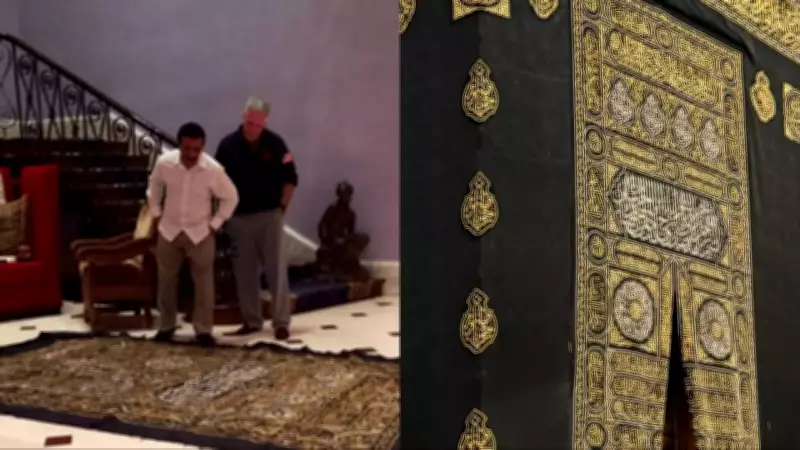
A shocking revelation from the latest batch of US Department of Justice-released Epstein documents has triggered profound outrage across the Muslim world. A newly surfaced photograph shows what appears to be a portion of the Kaaba's sacred covering, known as the Kiswa, laid out on the floor with Emirati billionaire Sultan Ahmed bin Sulayem and convicted sex offender Jeffrey Epstein standing over it.
Sacred Symbol Desecrated in Epstein's Residence
The black fabric with distinctive gold Quranic embroidery, clearly identifiable as part of the Kaaba's sacred covering, was previously revealed to have been sent to Epstein's private residence. This disclosure has generated deep alarm and anguish among Muslims globally who consider the Kaaba the holiest site in Islam.
Traditionally, fragments of the Kiswa are preserved or distributed under strict religious protocols, making the revelation that such a sacred object may have been used as a carpet inside a private home—particularly one associated with a convicted child sex offender—especially devastating. Social media platforms have been inundated with expressions of grief, anger, and disbelief, with countless users demanding accountability and clearer explanations about how one of Islam's most revered symbols ended up in such a context.

Documentary Evidence of Sacred Shipment
Earlier documents from the DOJ's extensive Epstein Files, released under the Epstein Files Transparency Act, had already triggered international controversy by revealing that fragments of the Kiswa were shipped from Saudi Arabia in 2017 to Epstein's private US residence. The Kaaba's Kiswa holds immense spiritual significance for Muslims worldwide, with millions of pilgrims touching it during tawaf rituals or circumambulation of the Kaaba each year.
According to multiple reports summarizing the unsealed correspondence:
- Three pieces of the Kiswa were involved in the shipment that reached Epstein's residence in Florida or the US Virgin Islands in early 2017
- The arrangement was facilitated through international air freight with the parcel reportedly declared as "artwork" for customs purposes
- Emails detail coordination between a UAE-based businesswoman and a Saudi intermediary, including invoices, customs documentation, and delivery arrangements
- One piece reportedly came from inside the Kaaba, another from the previously used outer covering, and a third from material made in the same tradition but never actually deployed on the Kaaba
Cultural and Religious Backlash Intensifies
The disclosure has ignited intense backlash across Muslim communities and social networks, with commentators describing the image of Sulayem and Epstein examining the Kiswa on the floor as profoundly disrespectful and offensive. Critics argue that items connected to the Kaaba should never be separated from their ritual context or circulated outside designated religious channels, especially to someone with Epstein's criminal legacy.
Social media responses have ranged from calls for official clarification to broader discussions about religious custodianship and cultural responsibilities surrounding sacred artifacts. Many have questioned the oversight mechanisms that allowed such transfers to occur and debated the ethical implications of sacred objects entering private hands without proper religious sanction.
Unanswered Questions and Ongoing Scrutiny
Despite the public disclosure of these documents, numerous key questions remain unresolved:
- The files do not clarify the exact purpose behind the shipment to Epstein
- The detailed nature of relationships with intermediaries involved remains unclear
- How the sacred items came to be selected for export hasn't been explained
- Official Saudi or UAE authorities haven't issued statements affirming or contesting the correspondence details
Analysts note that while historical practice allows for distribution of Kiswah fragments under certain conditions, such transfers are typically strictly controlled and seldom reach private hands without formal sanction. The uncertainty surrounding this specific case has fueled further speculation and debate within religious and diplomatic circles.

The revelations add another controversial dimension to the complex and far-reaching Epstein Files, a massive cache of documents that continue to yield surprising details about his global network and interactions long after his death. For observers in the Muslim world and beyond, the circulation of such a sacred religious symbol through private channels—especially associated with one of recent history's most infamous figures—has struck an exceptionally sensitive nerve, raising fundamental questions about religious respect, cultural preservation, and ethical boundaries in international exchanges.