

Karnataka Grapples with Escalating Private Bus Safety Crisis
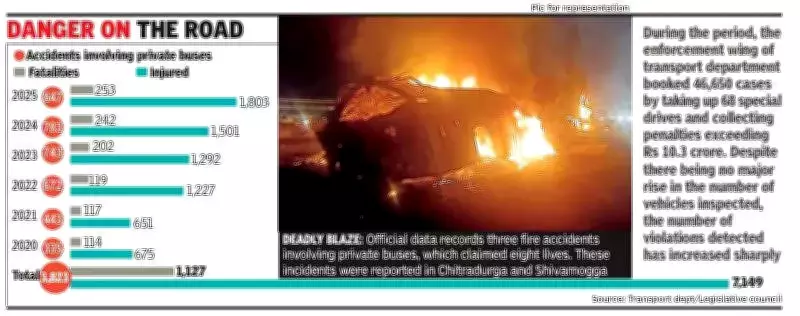
Bengaluru has become the focal point of a severe road safety crisis, as official data from the state transport department reveals a shocking toll: private bus accidents have claimed 1,127 lives over the past six years. This alarming statistic is accompanied by 3,823 reported accidents, largely attributed to driver negligence, technical faults, and blatant violations of established road safety norms.
A Disturbing Upward Trend in Casualties
The situation has deteriorated dramatically in recent years, with the numbers painting a grim picture of escalating danger. In 2020, the state recorded 335 private bus accidents. By 2025, that figure had more than doubled to a staggering 847 accidents. The human cost of this surge is even more devastating.
Fatalities jumped from 114 in 2020 to 253 in 2025, representing a profound increase in loss of life. Meanwhile, the number of individuals injured in these incidents skyrocketed from 675 to 1,803 over the same period. The data also includes records of three separate fire accidents involving private buses, which resulted in eight fatalities and six injuries. These tragic fire incidents were reported in the districts of Chitradurga and Shivamogga.

Enforcement Efforts and a Rising Tide of Violations
The surge in accidents and casualties has intensified scrutiny on enforcement gaps, vehicle fitness standards, and operational practices within the private bus sector. In response to the crisis, the enforcement wing of the transport department has been active, booking 46,650 cases through 68 special drives and collecting penalties exceeding Rs 10.3 crore.
However, a concerning pattern has emerged. Despite no significant increase in the number of vehicles inspected, the detection of violations has risen sharply. Transport Minister Ramalinga Reddy, responding to questions from MLC D Arun regarding action against errant private operators, provided comparative data that highlights this trend.
In the 2020-21 period, regional transport offices (RTOs) inspected 23,086 vehicles and booked 3,922 cases. In stark contrast, during the current financial year so far, inspections have covered 20,289 vehicles, yet a much higher number of violations—11,165 cases—have been registered. This represents more than double the violations recorded just six years ago, indicating a deepening compliance problem.
Government Implements Strict Safety Deadline
In the wake of a series of fire incidents involving sleeper coach buses, the Karnataka state government has taken decisive action. A strict deadline of March 31 has been set for private bus operators to comply with a comprehensive set of enhanced safety norms. Officials confirm that stringent directions have been issued to both private bus operators and bus body builders, mandating adherence to prescribed standards aimed squarely at improving passenger safety.
The revised guidelines introduce several critical changes. Partition doors located behind the driver's cabin must be removed, as they have been identified as potential obstructions to evacuation through the front exit during emergencies. Furthermore, the use of berth sliders in air-conditioned sleeper buses has been prohibited. Officials cite significant safety risks associated with the manual sliding mechanisms that were often used in place of curtains.
Comprehensive New Safety Mandates
The transport department has rolled out specific, mandatory requirements for bus construction and operation. For 12-metre buses, a minimum of four emergency exits is now compulsory. Buses exceeding 12 metres in length must be equipped with at least five emergency exits. The installation of fire extinguishers has been made compulsory across all such vehicles. Additionally, the practice of transporting commercial goods in passenger buses has been strictly and unequivocally prohibited.
Officials state that these robust measures align with directions from the National Human Rights Commission. The commission has called on all states to implement recommendations from a pivotal safety study conducted by the Central Institute of Road Transport. As a key enforcement tool, fitness certificates (FCs) will categorically not be issued to any buses that fail to comply with these new and non-negotiable safety requirements.

The data and the government's response underscore a critical juncture for road safety in Karnataka. The rising death toll and accident rates point to systemic failures, while the new regulations represent a concerted, if belated, effort to curb the crisis and protect the lives of thousands of bus passengers across the state.





