

Kim Jong Un Pledges to Irreversibly Cement North Korea's Nuclear Status, Calls South Korea 'Most Hostile'
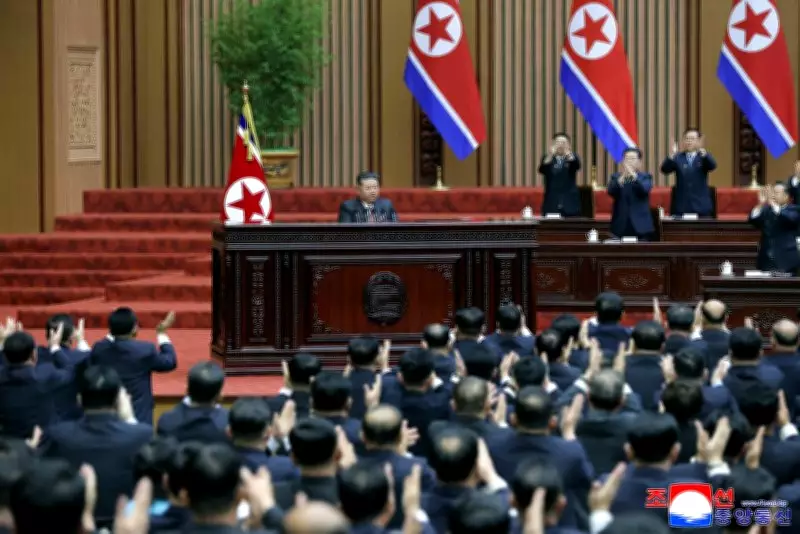
North Korean leader Kim Jong Un has made a resolute declaration to irreversibly cement his country's status as a nuclear power, while adopting a hard-line stance toward South Korea, which he labeled as the "most hostile" entity. This announcement was delivered in a speech to Pyongyang's rubber-stamp parliament, the Supreme People's Assembly, as reported by state media on Tuesday.
Accusations Against the United States
In his address, Kim Jong Un accused the United States of engaging in global "state terrorism and aggression," a statement widely interpreted as a reference to the ongoing conflict in the Middle East. He emphasized that North Korea will assume a more forceful role in a united front against Washington, capitalizing on rising anti-American sentiments worldwide. However, Kim notably refrained from directly naming US President Donald Trump, stating that the choice between confrontation or peaceful coexistence lies with his adversaries, and North Korea is prepared to respond accordingly.
Alignment with Previous Statements
These remarks largely align with Kim's statements from last month's ruling Workers' Party Congress, where he vilified Seoul but left the door open for dialogue with the Trump administration. He urged Washington to abandon its demands for North Korea's nuclear disarmament as a precondition for talks, underscoring a consistent strategic approach.

Constitutional Revisions and Policy Shifts
The Supreme People's Assembly, which concluded its two-day session on Monday, passed a revised constitution, though specific changes were not detailed by state media. Analysts had anticipated that the revisions might formally designate South Korea as a permanent enemy and eliminate references to shared nationhood. This move is in line with Kim's hardline stance, following his 2024 declaration that North Korea would abandon its long-standing goal of peaceful unification with the South.
Strategic Calculations and Regional Dynamics
Experts suggest that Kim's vilification of South Korea reflects his perception that Seoul is no longer a useful intermediary with Washington but rather an obstacle to his ambitions for a more assertive regional role. Additionally, Kim has demonstrated sensitivity to South Korean soft power, launching aggressive campaigns to block the influence of its culture and language within North Korea as part of efforts to tighten his family's authoritarian control.
Pride in Nuclear Expansion
In his speech, Kim expressed pride in North Korea's rapid expansion of nuclear weapons and missile capabilities in recent years, describing it as the "right" choice to counter future threats and the "hegemonic pursuits" of "gangsterlike" imperialists—a term frequently used by the North to refer to the United States and its allies. He asserted, "The dignity of the nation, its national interest and its ultimate victory can only be guaranteed by the strongest of power. The government of our republic will continue to consolidate our absolutely irreversible status as a nuclear power and will aggressively wage a struggle against hostile forces to crush their provocations and schemes."
Diplomatic Stalemate and Foreign Policy Priorities
Kim has suspended all meaningful dialogue with Washington and Seoul since the collapse of his second summit with Trump in 2019, which faltered over US-led sanctions. Recently, he has prioritized relations with Russia, dispatching thousands of troops and significant military equipment to support Moscow's war in Ukraine, likely in exchange for aid and military technology.
Future Prospects and Expert Analysis
As the war in Ukraine potentially winds down, analysts believe Kim may adopt a more measured approach toward Washington to preserve future dialogue opportunities, with the long-term aim of securing sanctions relief and tacit recognition as a nuclear state. However, some experts caution that recent US and Israeli actions, such as attacks on Iran and the killing of Tehran's previous supreme leader, may have raised Kim's threshold for reviving talks with Washington, complicating diplomatic prospects.






