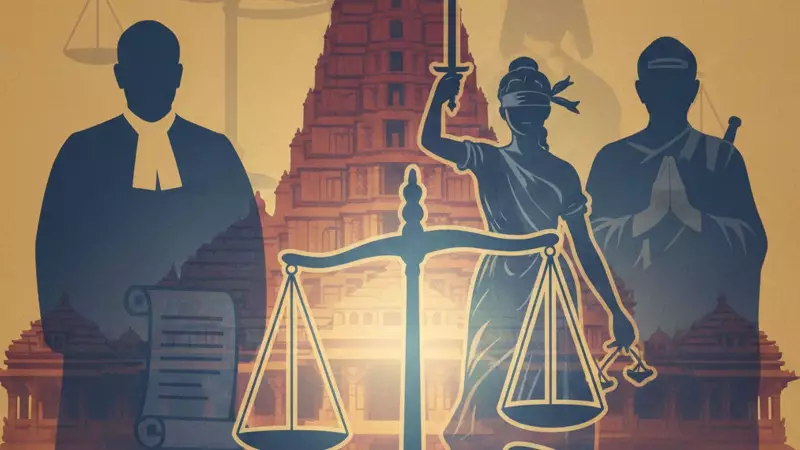
In a significant ruling that underscores the primacy of ritualistic protocol in Hindu temples, the Madras High Court has asserted that special honours within a temple precinct cannot be demanded as an absolute legal right. A bench comprising Justice S M Subramaniam and Justice C Kumarappan delivered this verdict while dismissing a writ appeal on December 15, firmly stating that the "first honour" in any temple is always reserved for the presiding deity.
The Core of the Dispute: Pancha Mudhirai Mariyadhai
The case revolved around a protracted ritualistic dispute concerning "Pancha Mudhirai Mariyadhai" (special honours) at the historic Sri Devaraja Swamy Temple in Kanchipuram. The original writ petition was initiated by the Thathadesikar Thiruvamsathar Sabha, seeking to prevent authorities from interfering with the temple's established customs under the Tamil Nadu Hindu Religious and Charitable Endowments (HR&CE) Act, 1959.
A single judge bench had previously noted the Advocate General's submission that, as per tradition, these special honours were confined to only five specific mutts: the Kanchi Kamakoti Peetam, Sri Ahobila Mutt, Sri Vanamamalai Mutt, Sri Parakala Jeeyar Mutt, and Sri Vyasarayar Mutt. The order stated that extending honours beyond these five would be subject to legal challenge.
The Appeal and Arguments Presented
The present appeal was filed by the Srirangam Srimath Andavan Ashramam, a third party not involved in the original case. Represented by senior advocate M S Krishnan, the appellant argued that the head of their mutt had received special honours at the temple on several occasions after 1991. They contended that the single judge's order dated February 8, 2023, led to the discontinuation of this practice without granting them a hearing, thus violating principles of natural justice.
Opposing this, advocate NRR Arun Natarajan, appearing for the HR&CE department, cited an established custom and a specific communication dated September 5, 1991. He maintained that special honours were traditionally conferred only on the five recognised mutts and any deviation required a formal determination under the provisions of the HR&CE Act.
Court's Observations and Final Ruling
The division bench meticulously examined the arguments and the legal framework. While acknowledging that the appellant mutt head had indeed been honoured on five occasions post-1991, the judges clarified that this historical practice did not automatically translate into a legally enforceable right. The court emphasized that such matters fall squarely within the purview of the competent authority under the HR&CE Act, specifically Section 63(e).
This section empowers the Commissioner or designated officers to inquire into and decide on claims to any honour, emolument, or perquisite in a religious institution. The bench made it unequivocally clear that honouring mutt heads, even if followed as a practice, cannot be elevated to the status of an absolute right that can be demanded. The primary and indisputable honour is always dedicated to the deity.
Granting limited relief, the court stated the appellant was at liberty to approach the competent authority under Section 63(e) of the Act for redressal. Ultimately, finding no infirmity in the single judge's order, the bench dismissed the writ appeal and declined to entertain the challenge, reinforcing the administrative and ritual hierarchy governed by the law.