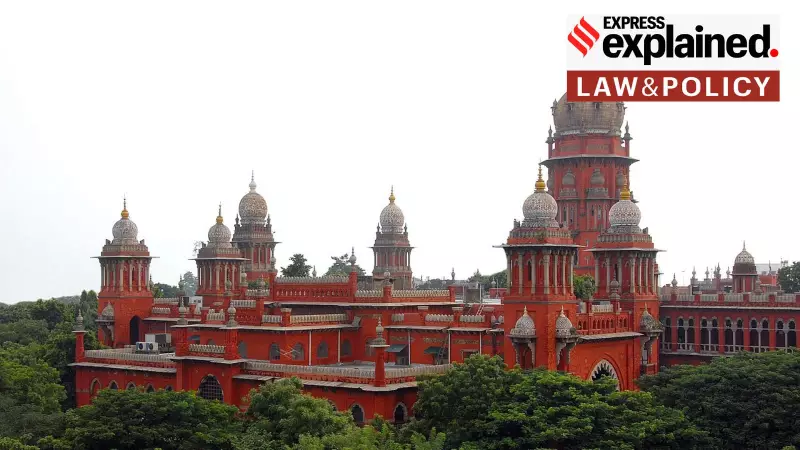
A Division Bench of the Madras High Court has firmly rejected the Tamil Nadu government's apprehensions of communal unrest over the lighting of a ceremonial lamp at the disputed Thiruparankundram hill near Madurai. The court, while permitting the ritual, imposed strict restrictions, allowing only a small temple team to perform the act with no public access.
Court Slams State's 'Imaginary Ghost' of Unrest
On January 6, 2026, a Bench comprising Justices G Jayachandran and K K Ramakrishnan delivered a significant verdict on the long-standing dispute. The judges dismissed the state's repeated warnings of potential disturbance in strong terms. They observed that the apprehension of unrest was "nothing but an imaginary ghost created by them for their convenience sake and to put one community against other community under suspicion and constant mistrust."
The Bench went further, stating it was "ridiculous and hard to believe the fear of the mighty State," and suggested disturbance would only occur "if such disturbance is sponsored by the State itself." The court held that allowing a limited team of temple officials to ascend the hill once a year for the Karthigai Deepam ritual was a manageable exercise.
The Historical and Legal Tapestry of Thiruparankundram
The Thiruparankundram hill, rising about 1050 feet on Madurai's outskirts, is a microcosm of India's layered religious history. At its base is the ancient Arulmigu Subramanian Swamy Cave Temple. The hill also houses centuries-old Jain rock beds and, at its summit, the burial site of Sufi saint Sikkandar Badhusha, marked by a dargah. This convergence has led to the hill being known by multiple names, including "Samanar Hill" and "Sikkandar Hill."
Legally, the hill's status was partly defined by a 1923 court ruling following a 1920 suit. The judgment held that most of the unoccupied hill and pilgrim path belonged to the temple Devasthanam, while the peak, the area around the mosque (Nellithope), and the steps leading to it were Muslim property. This arrangement has been the bedrock of subsequent conflicts.
The Deepathoon Dispute and the Court's Modifications
The immediate trigger was a petition filed in late November 2025 by a group of worshippers. They sought permission to light the Karthigai Deepam on December 3, 2025, at a stone pillar on the hill known as "Deepathoon." A Single Judge allowed the petition on December 1, viewing it as a restoration of religious practice.
The State government and the Hindu Religious and Charitable Endowments (HR&CE) Department appealed, raising procedural and law-and-order concerns. The police also imposed prohibitory orders, preventing the lamp from being lit on the festival day.
The Division Bench examined the nature of the pillar and confirmed it was indeed a Deepathoon, noting its carved cavity designed to hold oil and wicks, thus rejecting claims it was merely a survey marker. However, the Bench modified the Single Judge's order. It directed that the Devasthanam may light the lamp at the Deepathoon only through a limited team, with absolutely no public access to the hilltop. The District Collector was tasked with coordinating the exercise, in compliance with conditions set by the Archaeological Survey of India to protect the monument.
This judgment adds another chapter to the hill's contentious history, which has seen disputes over flagstaff replacements and animal sacrifices in recent years. The court's sharp critique of the state's security rationale and its balanced, restrictive order aim to navigate the fine line between religious practice and preserving communal harmony at this sensitive site.