Madras High Court Proposes Symbolic Prayer Solution for Thiruparankundram Hill Dispute
In a significant development, the Madras High Court has put forward a suggestion to the Tamil Nadu government to resolve a contentious issue regarding religious practices at Thiruparankundram hill in Madurai. Justice G R Swaminathan of the Madurai bench proposed that the state could permit a group of five individuals, to be named by the court, to offer symbolic prayers at the site. This suggestion aims to show respect to earlier court orders while addressing law and order concerns.
Court's Suggestion Amid Contempt Proceedings
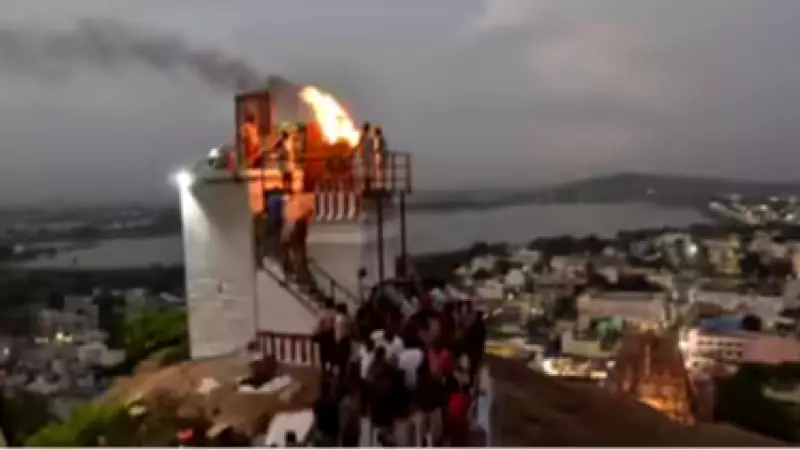
The court made this suggestion during hearings on contempt petitions filed over non-compliance with a previous order that directed the lighting of the Karthigai deepam (lamp) at the deepathoon (stone pillar) atop the hill. Justice Swaminathan emphasized that this was merely a suggestion and not a formal direction, stating that the symbolic prayers could be conducted without lighting a lamp and confined to a 15-minute duration.
The judge specifically stated: "I suggest that respect to the order passed by this court can be shown by permitting a group of exactly five persons to be named by this court to go to the lower peak of the hillock where deepathoon lies so that symbolic prayers can be offered."

Collector's Affidavit and Law and Order Concerns
The suggestion came after Madurai District Collector K J Praveen Kumar filed an additional affidavit explaining his decision to promulgate prohibition orders on December 1, 2025. The collector clarified that these orders were issued under Section 163 of the Bharatiya Nagarik Suraksha Sanhita (BNSS), 2023, solely to prevent potential law and order situations, not to hinder temple authorities from implementing the high court's directive to light the lamp.
In his affidavit, the collector noted: "One factor that I had kept in mind was that the temple management would be enabled to implement the court order only if there is no law and order situation in the hillock area. The prohibition issued under Section 163 of BNSS, 2023 definitely did not contemplate the hindrance to temple officials lighting the lamp in accordance with the judgment of the High Court."
Court's Observations on Frustration of Order
Justice Swaminathan observed that despite the collector's intentions, the prohibitory order had effectively frustrated the implementation of the court's earlier directive. The judge noted that police authorities had relied on the collector's order to resist compliance with the court's judgment, taking shelter behind the administrative directive rather than facilitating the religious ceremony as ordered.
The court has adjourned the hearing to March 4, 2026, after the state government requested time to consider the court's suggestion and respond accordingly.
Closure of Contempt Proceedings Against Minister
In a related development, Justice Swaminathan closed a sub-application seeking to initiate contempt proceedings against State Minister S Reghupathy for his reported statements on the issue. The judge strongly criticized the minister's comments, describing them as giving a "mischievous political spin" to the situation.
Justice Swaminathan remarked: "I have no doubt that the statement attributed to the minister deserves severe condemnation. When the writ court had permitted lighting the lamp atop the hill, it is only the division bench or the Supreme Court which alone can hold otherwise. It is not for any other authority, let alone a state minister, to dare to say that such lighting cannot be permitted."
The judge clarified that while closing the sub-application for now, he would not hesitate to reopen it if circumstances warrant, emphasizing that the principle of sub-judice applies to the matter and should be respected by all parties involved.

Broader Implications and Next Steps
This case highlights the delicate balance between judicial directives, administrative authority, and religious practices in India. The court's suggestion of symbolic prayers represents a potential compromise that acknowledges both the legal mandate and practical law enforcement concerns. As the state government considers its response, all eyes will be on the March 4 hearing to see whether this proposed solution gains traction or if further legal battles ensue over the implementation of religious ceremonies at this historically significant site.