

Nagaur Police Crack Elderly Woman's Murder Case Using Postmortem Precision Clue
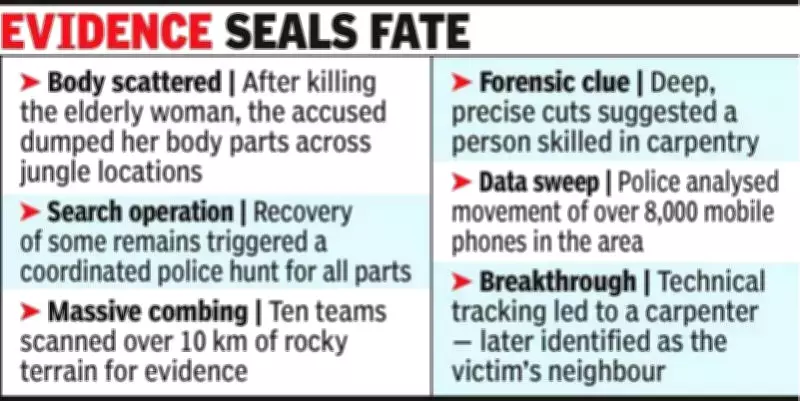
In a chilling case from Nagaur, Rajasthan, police have solved the brutal murder of a 75-year-old woman after a key observation in the postmortem report about the precision of body dismemberment led them directly to her neighbor, a carpenter by profession. The breakthrough came from forensic experts noting that the severing of limbs and head displayed a level of accuracy typically associated with someone skilled in carpentry.
Victim and Accused Identified
The victim has been identified as Nathi Devi, a 75-year-old resident of Paladi Kalan. The main accused is her neighbor, Mukesh Bharti, a 38-year-old carpenter. Police have also detained Bharti's wife, Maya, and his nephew, Chandanpuri, as co-conspirators in what appears to be a robbery-motivated murder.
According to police sources, the elderly woman was wearing jewellery valued at nearly Rs 5 lakh, which investigators believe was the primary motive behind the crime. The accused allegedly conspired to kill her to steal this valuable jewellery.

Discovery of the Crime and Investigation
The grisly discovery occurred on Monday when villagers found a sack containing the woman's torso in a forested area under the jurisdiction of Padukalan police station. The head and limbs had been severed from the body. Nagaur SP Roshan Meena stated that the horrific nature of the crime triggered an immediate and massive police response.
"We formed 10 specialized teams and deployed nearly 300 personnel, along with drones and dog squads, to comb through approximately 10 kilometers of rocky terrain," SP Meena explained during a briefing about the investigation.
On Wednesday, investigators made further grim discoveries, recovering the victim's severed head and legs from two separate sacks dumped at different locations. This appeared to be a deliberate attempt to mislead the investigation by scattering body parts across multiple sites.
The Crucial Breakthrough
The turning point in the investigation came from the postmortem examination report. Forensic experts noted that the dismemberment showed remarkable precision—the kind typically associated with someone trained in carpentry or similar skilled work. This observation provided investigators with their first significant lead regarding the perpetrator's possible profession.
Another crucial clue emerged from the sacks containing the body parts. Investigators found fodder inside these sacks, which became an important piece of evidence in tracing the crime back to the accused.
Using these leads, the police cyber cell analyzed approximately 8,000 mobile numbers before narrowing their suspicion to Mukesh Bharti, who lived in the same village as the victim. During a raid at Bharti's house and enclosure, police discovered bloodstains on the floor and in stored groundnut fodder.
Evidence Collection and Confession
Further investigation revealed blood traces in Bharti's Wagon-R car, which police believe was used to transport and dump the body parts. Authorities also recovered an axe that is believed to have been the murder weapon.
During interrogation, Bharti allegedly confessed to the crime and named his wife Maya and nephew Chandanpuri as co-conspirators in both the killing and the subsequent disposal of the body. According to police statements, all three were involved in planning and executing the murder and robbery.
SP Meena emphasized that the case was solved through tight coordination and technical investigation, with multiple teams working around the clock to piece together the evidence. The combination of forensic observation, technical analysis, and traditional police work proved instrumental in cracking this complex case within days of the body's discovery.
Bharti was formally arrested on Friday, while his wife and nephew remain in police custody as the investigation continues to uncover additional details about the conspiracy and execution of this brutal crime.






