Nagpur High Court Transforms Legal Penalties into Lifeline for Economically Vulnerable Citizens
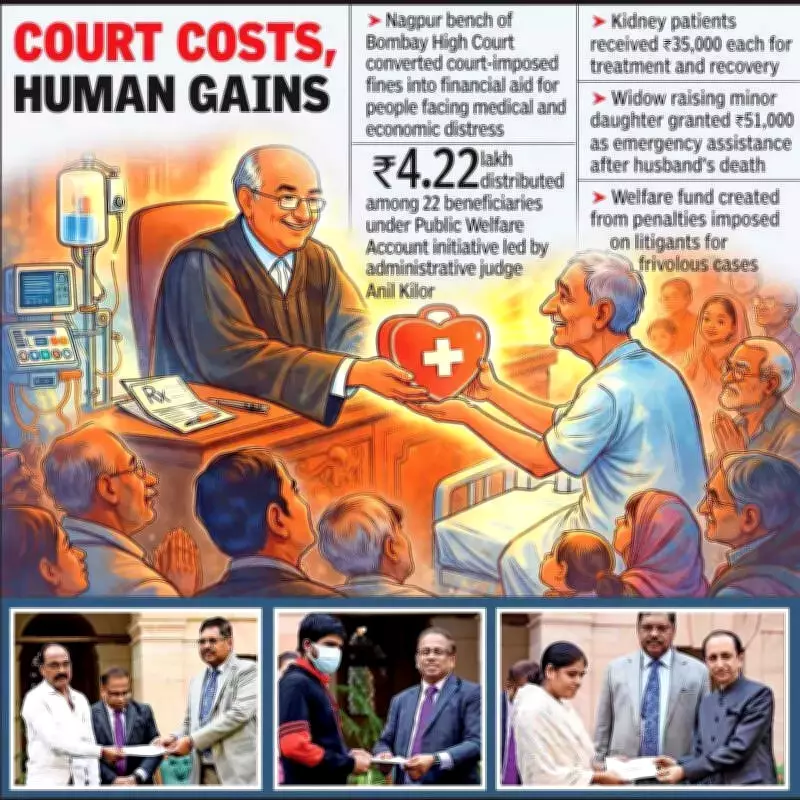
In an unprecedented humanitarian initiative, the Nagpur bench of the Bombay High Court has demonstrated how judicial institutions can extend their role beyond traditional legal adjudication. On Saturday, the court distributed Rs4.22 lakh among 22 beneficiaries facing severe medical and financial hardship, converting court-imposed penalties into a vital support system for those in distress.
From Court Fines to Compassionate Assistance
The innovative program, spearheaded by administrative judge Anil Kilor, drew funds from a public welfare account established following directions issued in suo motu public interest litigation in 2021. The registry opened this account at Union Bank of India in January this year, and within just two months, it accumulated more than Rs17 lakh. The majority of this money originated from penalties imposed during court proceedings, including fines levied on litigants for filing frivolous cases or wasting the court's valuable time.
"Until now, such funds were routinely transferred to the High Court Legal Aid or to the High Court and District Court Bar Associations," explained registrar Bhushan Kshirsagar. "The courts impose costs in many matters — sometimes Rs500 or more — when parties cause unnecessary litigation or repeatedly default. Instead of letting the funds remain unaccounted, the idea was to ensure the amount reaches people who genuinely need help for medical treatment and other urgent needs."

Transparent Distribution Mechanism
To guarantee transparency and proper allocation, a dedicated panel was formed under the leadership of the Nagpur collector and municipal commissioner, with the high court registrar serving as member secretary. This committee meticulously reviews all assistance requests and supporting documentation before making recommendations, ensuring that funds reach only those with verified, genuine needs.
Beneficiaries and Their Stories
The distribution program brought tangible relief to numerous individuals confronting overwhelming challenges:
- Arun Shendre and Prajwal Dhongare, both from economically underprivileged families who had undergone kidney transplant surgeries, received Rs35,000 each to support their recovery processes.
- Dumeshwari Bahe, widowed after a construction-site accident and left to raise her seven-year-old daughter alone, was granted Rs51,000 as immediate assistance following her husband's tragic death.
- Ten extremely poor patients either recovering from kidney transplants or undergoing continuous ambulatory peritoneal dialysis received Rs35,000 each. This group included post-transplant patients Lalita Tater, Anup Kujur, Shivam Jaitwar, and Mukul Wandile, along with CAPD patients Sarita Baghele, Vahida Sheikh, Santosh Kamble, Jyoti Jaiswal, Sukhdev Meshram, and Prajwal Thombre.
- The court also responded to a media report highlighting the condition of Raju Baburao Isambare, an osteoporosis patient unable to afford treatment. After verifying medical records from GMCH, Nagpur, the bench sanctioned Rs21,000 for his essential medical care.
- Nine individuals unable to afford assistive devices — Naresh Bhosale, Ekramuddin, Nilwant Bante, Vimal Pahune, Vitthal Dethe, Shankar Sonkusre, Indramala Bagade, Rajesh Mele, and Balwant Nagtode — were provided with hearing aids worth Rs5,000 each, with payments made directly to the vendor to ensure proper procurement.
A New Dimension of Justice
For many present at the distribution program, this initiative represented a profound evolution in how judicial institutions can occasionally step beyond their conventional boundaries. Members of the court fraternity observed that on this occasion, justice manifested in a quieter, more compassionate form — offering not just legal resolution but tangible relief and restored dignity to people confronting hardships far removed from typical courtroom arguments.

This innovative approach demonstrates how systemic resources, when creatively redirected, can address pressing social needs. By transforming legal penalties into humanitarian assistance, the Nagpur bench has established a replicable model that other judicial bodies might consider adopting, potentially expanding this compassionate impact across the broader legal landscape.