

Nagpur High Court Upholds ITI Staff Transfers Following ICC Report
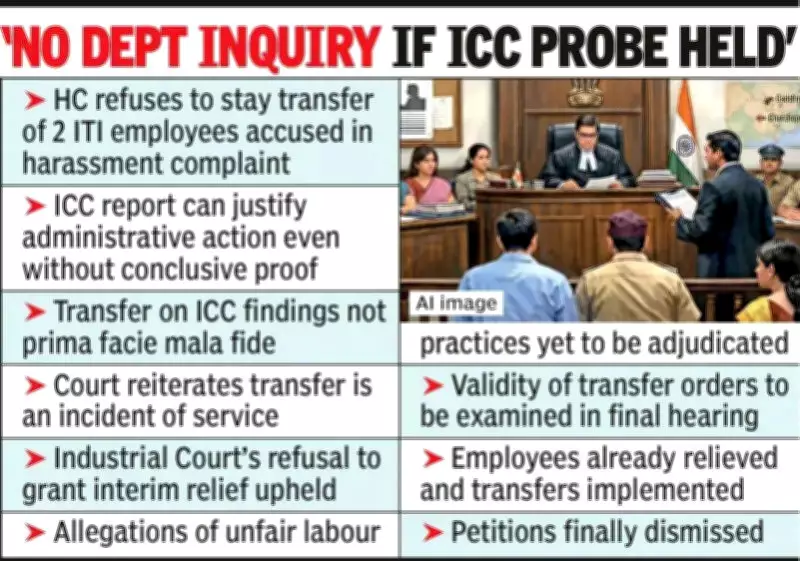
The Nagpur bench of the Bombay High Court has recently upheld interim orders that refused to stay the transfer of two Industrial Training Institute (ITI) employees. The court ruled that administrative action based on an internal complaints committee (ICC) report cannot be termed prima facie mala fide, even if allegations of sexual harassment remain unproven.
Petitions Dismissed by Justice Prafulla Khubalkar
Justice Prafulla Khubalkar dismissed petitions filed by a storekeeper and a craft instructor, both posted at ITI, Wardha, at the time of the dispute. The petitioners had challenged orders of the Industrial Court in Nagpur, which earlier rejected their plea for an interim stay on transfer orders issued in July 2025.
Background of the Case and ICC Inquiry
The case stemmed from a complaint filed by a woman colleague, following which the ICC conducted an inquiry and submitted its report on July 15, 2025. While the committee did not record definitive findings establishing harassment, it observed that a lack of direct evidence is common in such cases and found no reason to disbelieve the complainant's allegations. Consequently, the ICC recommended the transfer of both employees and the withholding of one increment.

Implementation of Transfer Orders
Acting on these recommendations, authorities transferred the instructor to ITI Bhamragad in Gadchiroli and the storekeeper to Pombhurna in Chandrapur. The petitioners argued that the transfers were punitive in nature, carried out without a formal departmental inquiry under service rules, and based on a flawed ICC process allegedly conducted in violation of provisions of the Sexual Harassment of Women at Workplace (Prevention, Prohibition and Redressal) Act, 2013.
Arguments Presented by Petitioners and State
They further contended that the ICC itself lacked jurisdiction and the action amounted to unfair labour practices. However, opposing the petitions, the state authorities represented by KH Bhondge and the complainant maintained that the transfers were administrative decisions taken in the interest of workplace safety and dignity, and were already effected.
High Court's Conclusion and Ruling
Concluding that the Industrial Court's reasoning was neither arbitrary nor perverse, the high court dismissed both the petitions and declined to grant interim relief, while keeping all substantive issues open for determination in appropriate proceedings. This decision reinforces the authority of internal committees in addressing workplace complaints, even when allegations are not conclusively proven.






