

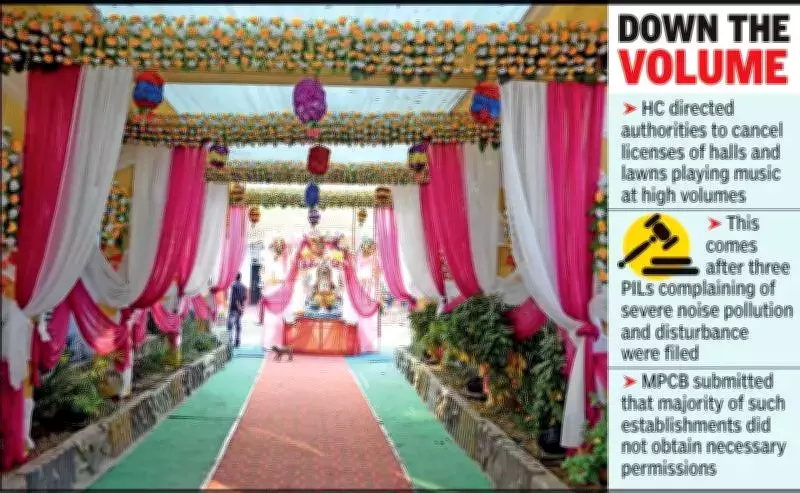
Nagpur High Court Directs Authorities to Verify Permissions for Event Venues in Civil Lines
The Nagpur bench of the Bombay High Court issued a significant directive on Thursday, ordering local authorities to conduct a thorough verification of all lawns, marriage halls, and club houses in the Civil Lines area of Nagpur. The court emphasized the need to ensure these establishments possess valid permissions and strictly adhere to noise pollution regulations, with a stern warning that licences must be cancelled if any violations are uncovered.
Court's Observations on Noise Pollution Enforcement
A division bench comprising Justices Anil Pansare and Nivedita Mehta delivered this ruling while hearing three Public Interest Litigations (PILs) that raised concerns about noise pollution stemming from social events hosted at such venues. The court highlighted that the enforcement of the Noise Pollution (Regulation and Control) Rules, 2000, along with guidelines issued by the Maharashtra Pollution Control Board (MPCB), falls squarely under the responsibility of the local administration.
During the proceedings, counsel for the Nagpur Municipal Corporation provided the court with a list of approximately 13 establishments in Civil Lines. These included well-known venues such as Swagat Lawn and Hall, Great Grand Lawn, Season Lawn, Sarpanch Bhavan, Gondwana Club, CP Club, Srushti Lawn, Officers Club, Ladies Club, Prestige Hall and Lawn, Jawahar Vidyarthi Sabhagruha, Satpuda Lawn, and Deshpande Sabhagruha.

Compliance Requirements and Current Status
The bench referenced a circular issued by the MPCB on November 24, 2016, which mandates that such establishments must install sewage treatment plants, maintain soundproofing systems, and obtain prior permission from competent authorities before using loudspeakers, DJs, or Dolby sound systems. When questioned about compliance, the MPCB informed the court that, with few exceptions, most of these venues had not secured the necessary permissions.
In response to this submission, the court directed the collector, police, and municipal commissioners to verify the current status of licences granted to all lawns, marriage halls, and club houses operating in the Civil Lines area. The bench made it clear that if permissions were found to have been granted but the establishments were not complying with the prescribed conditions, authorities must take appropriate action, which could include the cancellation of licences.
This directive underscores the court's commitment to addressing noise pollution issues in residential areas and ensuring that social events do not disrupt the peace and well-being of the community. The ruling is expected to lead to increased scrutiny and enforcement measures by local bodies in Nagpur.






