Nagpur High Court Proposes Unprecedented Financial Penalty for Hospital Parking Violations
The Nagpur Bench of the Bombay High Court has proposed a groundbreaking financial penalty mechanism to address long-standing violations by private hospitals accused of converting designated parking spaces into commercial areas. Simultaneously, the court has raised serious questions about the accuracy of an affidavit submitted by the Assistant Commissioner of Police (Traffic) after a court-appointed inspection contradicted his claims.
Fourteen Years of Unresolved Violations
Hearing Public Interest Litigations (PILs) filed by the Dhantoli Nagrik Mandal through counsels Ashutosh Dharmadhikari and Ashwin Deshpande, a bench comprising Justices Anil Kilor and Raj Wakode expressed frustration over the persistent nature of the problem. The court noted that despite "numerous orders" issued over the past 14 years, there has been "no change on the ground and the actual problem on the field remains identical to what it was before."
The High Court observed that certain hospitals have "never used" the areas specifically demarcated for parking in their sanctioned building plans. Instead, these spaces are being utilized for commercial purposes, creating significant public inconvenience and violating urban planning regulations.

Innovative Financial Penalty Approach
Acknowledging the practical difficulties of constant monitoring by municipal authorities, the bench decided to adopt a novel approach to enforcement. Rather than directing immediate punitive action, the judges ordered the Public Works Department to provide prevailing commercial rental rates for such misused spaces within two weeks.
Based on these commercial rates, the Nagpur Municipal Corporation (NMC) has been directed to issue show-cause notices within one week to all hospitals found violating parking regulations. These notices will ask the hospitals to explain why a penalty "equivalent to four times of such commercial rate" should not be recovered as monthly charges.
The hospitals have been granted four weeks to respond to these notices and may also present their submissions directly before the court on the next hearing date following the notice period's expiration. The court clarified that if it ultimately determines such penalties are warranted, "further modalities for the same will be considered and decided." Any recovered penalty amounts would be specifically allocated "for the treatment of poor patients and public welfare."
Traffic Affidavit Contradicted by Court Inspection
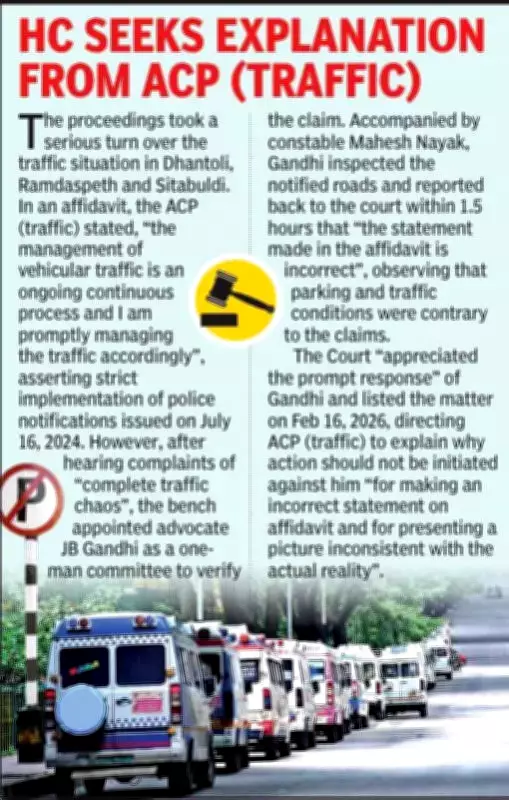
The proceedings took a serious turn regarding traffic management in the Dhantoli, Ramdaspeth, and Sitabuldi areas of Nagpur. In an affidavit submitted to the court, the ACP (Traffic) stated that "the management of vehicular traffic is an ongoing continuous process and I am promptly managing the traffic accordingly," asserting strict implementation of police notifications issued on July 16, 2024.
However, after hearing complaints about "complete traffic chaos" in these areas, the bench appointed advocate JB Gandhi as a one-man committee to verify the traffic officer's claims. Accompanied by constable Mahesh Nayak, Gandhi conducted an immediate inspection of the notified roads and reported back to the court within just 1.5 hours.
Gandhi's inspection findings directly contradicted the ACP's affidavit, with the advocate reporting that "the statement made in the affidavit is incorrect." He observed that actual parking and traffic conditions on the ground were completely contrary to the claims presented in the official affidavit.
Court Demands Explanation from Traffic Officer
The High Court "appreciated the prompt response" of advocate Gandhi and has listed the matter for further hearing on February 16, 2026. The bench has directed the ACP (Traffic) to explain why action should not be initiated against him "for making an incorrect statement on affidavit and for presenting a picture inconsistent with the actual reality."

This dual approach by the Nagpur Bench—proposing an innovative financial penalty system for hospital violations while simultaneously holding public officials accountable for inaccurate reporting—represents a significant development in judicial oversight of urban governance issues in Maharashtra's second capital.