Nagpur Police Intervene to Illuminate Single Mother's Home After Prolonged Darkness
In a heartening display of community support and administrative action, a 47-year-old single mother residing in the Chinchbhuvan area of Nagpur has finally seen light return to her modest home. After enduring more than two and a half months without electricity, Surekha Masram received a newly installed electricity meter on Sunday, thanks to the proactive assistance of the Beltarodi police station.
A Struggle Against Adversity and Bureaucratic Hurdles
Surekha Masram, who works as a domestic help, has faced significant hardships in her life. She was driven out of her family home by her husband's relatives and has since raised her daughter single-handedly while living in a small hut. Her quest for a basic amenity like electricity became another daunting challenge when she applied for a power connection.
The state electricity department initially refused her application, citing an ongoing property dispute and demanding a court order as a prerequisite. Undeterred, Surekha approached the judicial system, which ruled in her favor. The court explicitly directed the electricity department to provide her with a meter, recognizing her rightful claim.
However, even with the court order in hand, the process stalled. Sources indicate that electricity officials delayed the installation, reportedly fearing resistance from Surekha's estranged family members. This left Surekha and her daughter in a dire situation—without power, daily life became a struggle, and her daughter's studies suffered due to the absence of proper lighting at night.
Grievance Redressal Day: A Turning Point
The breakthrough came during the ‘Grievance Redressal Day’ (Takraar Nivaaran Din) event held at the Beltarodi Police Station on Saturday. Organized under the instructions of Commissioner of Police Ravinder Singal, the event was chaired by Deputy Commissioner of Police (Zone-4) Rashmitha Rao and conducted in the presence of Senior Police Inspector Mukund Kawade.
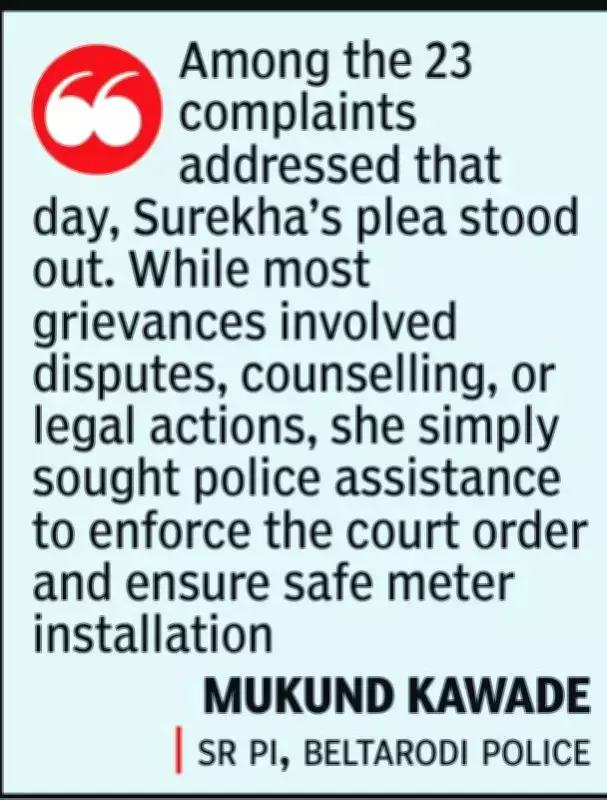
Among the 23 complaints addressed that day, Surekha's plea stood out. While most grievances involved disputes, counselling, or legal actions, her request was straightforward yet critical. She simply sought police assistance to enforce the court order and ensure the safe installation of her electricity meter.
Senior Police Inspector Mukund Kawade highlighted the uniqueness of her case, noting that it required direct intervention to bridge the gap between a judicial directive and its execution. In response, DCP Rashmitha Rao took immediate action, instructing officials to depute a beat constable to accompany Surekha. This officer was tasked with providing necessary protection and coordinating with electricity department officials to facilitate the meter installation.
Broader Impact of Police-Led Initiative
The grievance redressal event itself was a comprehensive effort to address community concerns. The complaints handled included:
- One forwarded from the Chief Minister's Office
- Two from the Guardian Minister's office
- Eleven from the Commissioner of Police's office
- Nine registered locally at the police station
After detailed hearings and enquiries, the police initiated appropriate actions ranging from counselling and mutual compromises to legal steps. This demonstrates a structured approach to problem-solving within the community.
Surekha's case, however, underscores a vital aspect of governance—the enforcement of court orders and the protection of vulnerable citizens. Her relief at finally having electricity is palpable, not just for practical reasons but as a symbol of justice served. It highlights how police intervention can transcend traditional law enforcement roles to address socio-economic barriers faced by individuals.
This incident serves as a reminder of the importance of accessible grievance redressal mechanisms and the role of authorities in ensuring that legal victories translate into tangible improvements in people's lives. For Surekha and her daughter, the light now shining in their home is more than just electricity; it is a beacon of hope and resilience.