

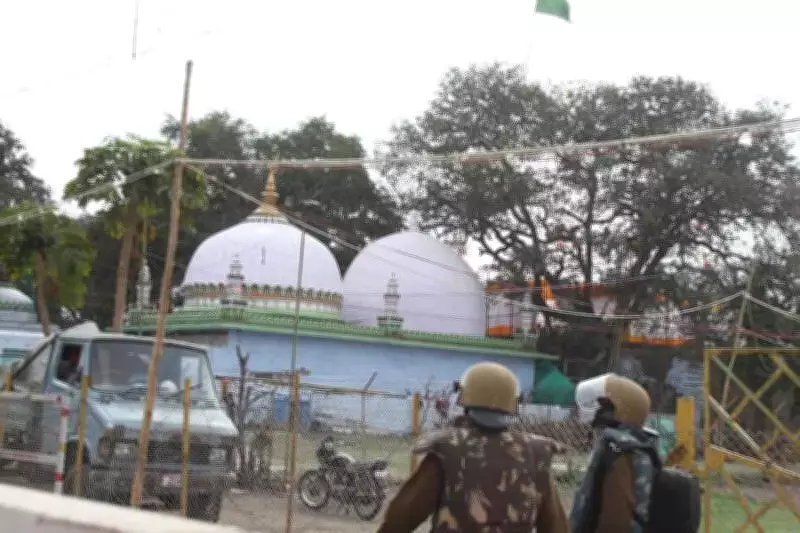
Senior advocate Salman Khurshid, representing the Maulana Kamaluddin Welfare Society in the disputed Bhojshala-Kamal Maula Mosque complex case, has argued before the Madhya Pradesh High Court that there is no conclusive evidence to show that a temple was demolished to build the mosque at the site.
Historical Context of the Site
Khurshid drew on historical texts to argue that by the time the Kamal Maula mosque was constructed in 1305 AD, there was no standing structure at the site to demolish. Citing historian Ram Sewak Garg's book Hazrat Maulana Kamaluddin Chisti Aur Unka Yug, he argued that the demolition of symbolic structures, including temples, was a feature of conquest that predated Indo-Muslim states. "It has nothing to do with rulers of a particular community," he told Justices Vijay Kumar Shukla and Alok Awasthi of the High Court's Indore bench on Thursday.
Iconoclasm Across Eras
Drawing further on articles by journalist Ezaz Ashraf and historian Richard M Eaton, Khurshid submitted that iconoclasm in Indian invasions dated to the 6th century AD, with Hindu kings also desecrating rival temples as acts of political authority, rooted in the belief that a king's rule was embodied in the deity.

Tracing the destruction of Dhar through the Parmar era, Khurshid drew a parallel with the Seven Cities of Delhi. "In 140 years, Dhar was looted and rebuilt multiple times. By 1270, Dhar was completely wrecked and ruined. There was nothing left for Muslim rulers to have destroyed," he submitted. By 1305, he argued, Muslim rulers who acquired Mandu and Dhar were focused not on "securing a win" but on establishing administrative control.
Disputed Idol Evidence
Turning to the submissions of petitioner Hindu Front for Justice's counsel, Vishnu Shankar Jain, Khurshid pointed to the petitioner's Bhojshala compilation, which references a Saraswati idol described as a standing figure of a Jain goddess carved in white marble and housed in the British Museum. It is attributed to a British officer who reportedly brought it from the vicinity of Dhar. He pointed out that the source cited was a Google link that returned an error, and that the museum's own records listed the idol's provenance as "unrecorded", with only a speculative attribution to "probably Gujarat or Rajasthan (west)".
British Museum Clarification
Khurshid then placed before the court a February 2003 letter from then British High Commissioner Rob Young to then Chief Minister Digvijaya Singh, which stated categorically that the sculpture in the British Museum is not the Saraswati idol from Bhojshala. The letter traced the confusion to a 1920s article in the journal Rupam, which had misidentified the statue based on an incomplete reading of an inscription. That error, he submitted, was corrected in the 1980s when Dr. Kirith Mankodi of Mumbai published a full reading establishing that the sculpture depicts the Jain goddess Ambika, identifiable by her attributes of a child and a lion. Khurshid argued that the High Commission's letter, grounded in information from the British Museum, carried greater evidentiary weight than the compilation's unverified reference.
Legal Questions on Title
He closed by returning to the legal question at the heart of the matter: even if the idol's origin were established, its relevance to the case would remain doubtful unless it could be tied to actual demolition, and ultimately to the question of title, which he described as the court's central concern.
Relying on the Ayodhya judgment again, he submitted that archaeological findings are inherently inferential and cannot conclusively establish title. The existence of a prior structure, without proof of its destruction or continuity of possession, cannot translate into a legal claim over present property. Title, he argued, must rest on legally admissible evidence tested through cross-examination, not on historical speculation.
Conclusion of Arguments
Khurshid concluded his argument and indicated he would submit a written summary before the court.

The court also heard Additional Solicitor General Sunil Kumar Jain, who addressed the site's status as a protected monument — retrospectively recognised since 1904 under provisions of the Ancient and Historical Monuments and Archaeological Sites and Remains (Declaration of National Importance) Act, 1951 — and submitted that a Waqf property claim through a 1935 notification stands invalidated on that basis. He is to continue his arguments on Friday.





