

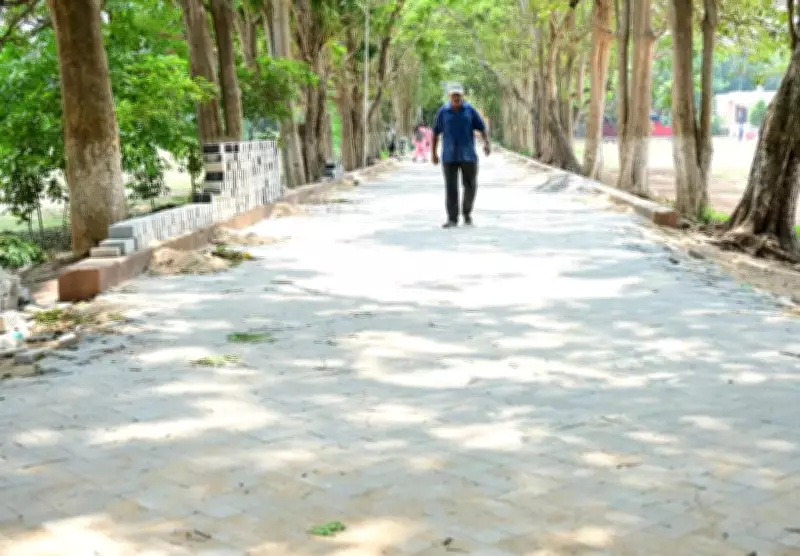
Orissa High Court Intervenes to Protect Public Health at Historic Stadium
In a significant ruling focused on public safety and heritage preservation, the Orissa High Court has issued a firm directive to immediately halt the laying of concrete paver blocks on the walking track inside Cuttack's Satyabrata Stadium. The stadium is located within the protected Barabati Fort area, a site of archaeological importance.
Court Cites Grave Health Hazards from Hard Paving
A bench comprising Justices K R Mohapatra and V Narasingh expressed deep concern over the health risks posed by the hard, non-shock-absorbing surface of the concrete blocks. The court's order stated that such surfaces can cause joint strain, foot problems, and significantly increase the risk of slips and falls, particularly endangering elderly citizens and children.
The bench emphatically declared, "In view of the health hazards posed by these concrete blocks... and since the authorities chose to sacrifice citizens’ basic right to walk safely, this Court directs the Archaeological Survey of India (ASI) to immediately stop laying paver blocks on the walking track of Satyabrata Stadium."

Directive for Complete Restoration and Compliance Deadline
The court's order goes beyond merely stopping the work. It mandates that all paver blocks already laid must be removed, with the track restored to its original 'un-paved' state. The Archaeological Survey of India has been instructed to submit a compliance affidavit by April 9, 2024. On that date, the ASI superintendent is required to appear personally before the court to demonstrate adherence to the order.
PIL and Allegations of Hasty, Questionable Spending
The court's intervention came during a hearing on March 26, 2024, while addressing a Public Interest Litigation (PIL) concerning various civic issues in Cuttack. The bench took cognizance of reports published in local vernacular newspapers highlighting the paving work.
Representing the bar association, president Manoj Kumar Mishra and secretary Avijit Patnaik, along with amicus curiae Bijay Kumar Dash, presented arguments before the court. They alleged that the work was proceeding "oblivious of the health hazards" and raised serious concerns about the timing and financial implications of the project.
A critical allegation presented was that public funds were being siphoned off with undue haste to pave the track at a time when the district administration was still in the process of submitting a Detailed Project Report (DPR) for the overall development of Satyabrata Stadium. This suggested the paving might be an isolated, premature expenditure.
Contradictory Claims and District Administration's Stance
During the proceedings, Prasanna Kumar Parhi, the deputy solicitor general, submitted that the work had already been stopped since the previous Wednesday. However, this claim was vociferously opposed by the members of the bar association, indicating a dispute over the facts on the ground.
It was also revealed in court that the district administration itself was unaware of the ongoing work to pave the walking track, pointing to a potential lack of coordination or oversight regarding activities within the protected fort area.
This ruling underscores the judiciary's role in safeguarding public health infrastructure and ensuring responsible use of public funds, especially in ecologically and historically sensitive zones like the Barabati Fort.






