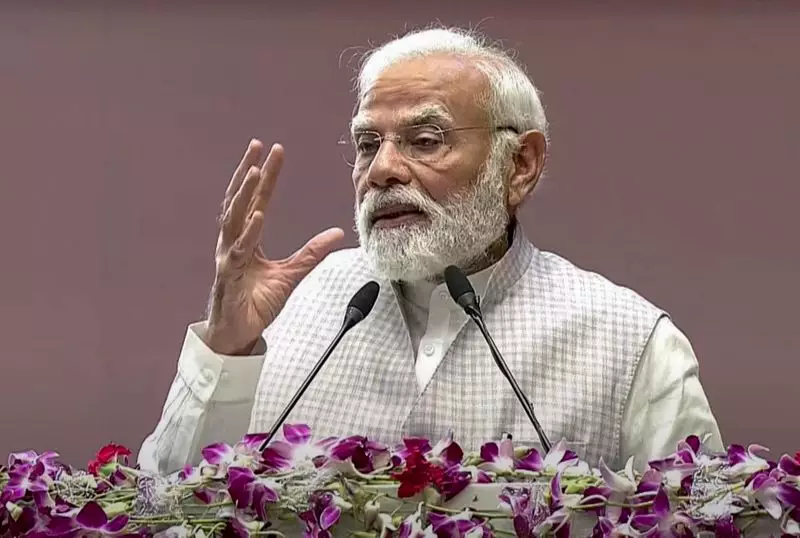
Prime Minister Narendra Modi has made a strong case for transforming India's judicial system to make justice more accessible to every citizen. During his address at the Supreme Court's 75th anniversary celebrations, the Prime Minister emphasized that the language of law must become more localized and simpler to ensure that common people can understand and engage with legal processes.
Bridging the Gap Between Courts and Common Citizens
The Prime Minister highlighted a significant barrier that prevents many Indians from accessing justice: the complex legal language that remains unfamiliar to most citizens. PM Modi stressed that when the language of justice becomes simplified and local, it empowers ordinary people to approach courts with confidence and understanding.
He pointed out that technological advancements and digital initiatives have already begun transforming how citizens interact with the judicial system. The integration of technology has created new opportunities to make legal processes more transparent and accessible to everyone, regardless of their background or education level.

Historical Context and Modern Transformation
Reflecting on the Supreme Court's journey since its establishment on January 28, 1950, the Prime Minister acknowledged the institution's rich legacy while emphasizing the need for continuous evolution. The Supreme Court has completed 75 years of service to the nation, building a remarkable history of upholding constitutional values and protecting citizens' rights.
PM Modi noted that the Indian judiciary has consistently strengthened the country's democratic framework through its landmark judgments and interpretations. However, he emphasized that the changing times demand corresponding changes in how justice is delivered and perceived by common citizens.
Technology as an Enabler of Judicial Access
The Prime Minister particularly emphasized how digital India initiatives are revolutionizing access to justice. Technological integration is breaking down traditional barriers that once made legal processes intimidating for ordinary people. From e-filing to virtual hearings, technology is making the judicial system more approachable and efficient.
He stressed that these technological advancements, combined with simplified legal language, can create a powerful combination that truly democratizes access to justice. When people can understand legal proceedings in their own language and navigate the system through digital platforms, the entire concept of justice becomes more inclusive.
The Prime Minister's vision extends beyond mere procedural changes. He envisions a judicial system where every Indian, regardless of their linguistic background or educational qualifications, can seek and obtain justice without feeling overwhelmed by complex legal terminology or procedures.
This push for localization and simplification represents a significant step toward realizing the constitutional ideal of equal justice for all. By making the language of law more accessible, the government aims to ensure that the benefits of India's robust judicial system reach every corner of society, particularly those who have historically faced barriers in accessing legal recourse.