32-Hour High-Stakes Operation Averts Catastrophic Propylene Disaster on Pune-Mumbai Expressway
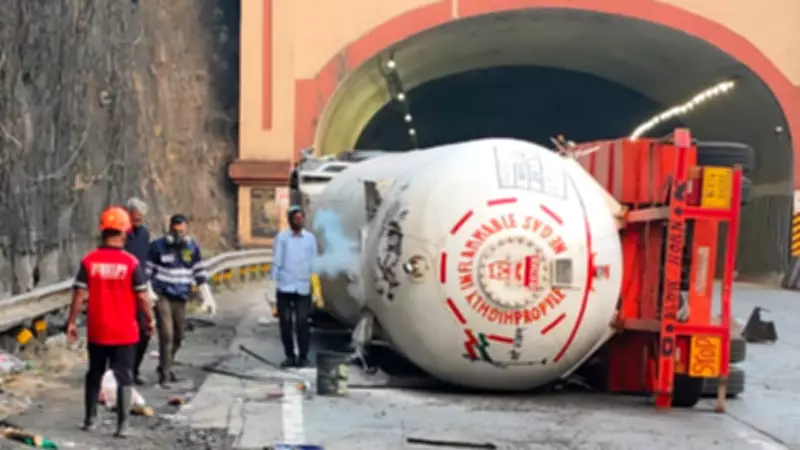
A meticulously executed 32-hour hazardous materials operation—characterized by split-second decisions, specialized expertise, and round-the-clock coordination—successfully averted what could have escalated into a catastrophic propylene gas disaster on the heavily trafficked Pune–Mumbai Expressway. The incident, which unfolded around 7:30 pm on Tuesday, involved a propylene tanker carrying nearly 21,000 kg of highly flammable compressed gas that overturned onto its side near the Adoshi tunnel.
Critical Situation and Immediate Response
ZN Gawade, technical director of Mec Elec Industrial Services in Thane, a private agency that played a pivotal role in the operation, described the ground situation as extremely volatile and critical. "All three top-mounted ball valves on the tanker were damaged in the rollover and were actively leaking. Liquid propylene was discharging from every connection, compelling authorities to halt traffic in both directions," Gawade explained. He further highlighted that Lower Explosive Limit readings were alarmingly high even 500 metres from the site, underscoring the severe explosion risk that loomed over the area.
Challenges and Strategic Interventions
Working under life-threatening conditions, the response team managed to arrest two of the three leaks—one liquid and one vapour valve. However, the third valve presented a formidable challenge. Bent sharply during the impact, its handle had jammed against the weld cap, rendering operation impossible while liquid propylene continued to escape.

Gawade reached the site the following morning, travelling against traffic flow in a police-escorted ambulance. After conducting a detailed technical assessment, the team opted for a high-risk decanting strategy. This involved transferring the tanker’s contents through the single operable vapour valve into multiple empty propylene tankers. "The objective was to reduce the liquid level inside the damaged tanker until the leaking valve began releasing vapour instead of liquid, significantly lowering the hazard," he elaborated.
Precision Execution and Multi-Agency Coordination
By around 4:30 pm, specialized transfer hoses were connected, and liquid transfer was initiated using pressure differential, with receiving tankers carefully depressurised. The process was repeated three times, each transfer conducted with extreme caution due to loosened valves and mechanical instability.
Once the leaking valve began venting vapour—indicating the liquid level had dropped below roughly 50%—authorities prepared for the next critical phase: lifting the overturned tanker. The operation was carried out with extensive multi-agency support, including:
- Police forces
- National Disaster Response Force (NDRF)
- Fire brigade
- Various state and local agencies
Four cranes and multiple fire tenders were deployed, and the lifting plan was rehearsed in detail before execution. As anticipated, the leak briefly intensified when residual liquid contacted the damaged valve via the dip pipe. The response team swiftly arrested the final leak, preventing escalation at a critical moment.
Final Stages and Successful Resolution
At around 1:30 am, the tanker was escorted through the ghat section under strict safety supervision. Despite still containing a significant quantity of propylene, another delicate operation was undertaken—partially opening the bent liquid valve to decant additional product into a fourth tanker.
The tanker was finally transported to the Khalapur tanker testing station, reaching the facility at around 5:00 am. By then, the technical team had worked continuously for over 32 hours, navigating one of the most complex and hazardous compressed-gas response operations witnessed on an Indian highway in recent years.
Key Takeaways and Broader Implications
Officials emphasized that the incident underscored not only the dangers associated with hazardous material transport but also the critical importance of:

- Specialized expertise in handling such emergencies
- Precise execution of technical strategies
- Seamless inter-agency coordination
This high-stakes operation serves as a stark reminder of the potential for large-scale disasters on vital transport corridors and highlights the need for robust emergency response frameworks to safeguard public safety and infrastructure.