

Rajasthan High Court Mandates Major Police Reforms to Address Systemic Delays
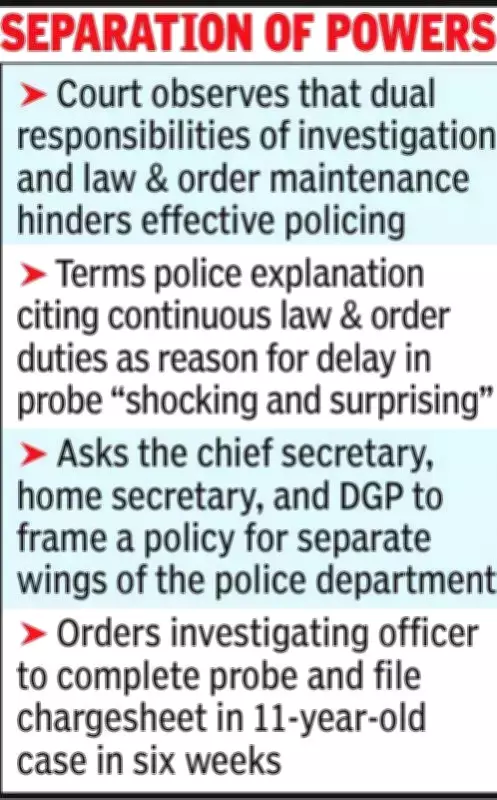
The Rajasthan High Court has issued a landmark directive to the state government, ordering the creation of a policy that separates police department functions into two distinct wings: one dedicated to maintaining law and order, and another focused solely on investigating cases registered at police stations. This significant judicial intervention aims to overhaul policing efficiency and ensure timely justice delivery across the state.
Court Expresses Displeasure Over 11-Year Investigation Delay
The court's directions emerged from a case that highlighted shocking systemic failures. A single bench of Justice Anoop Kumar Dhand passed the order on March 16 while disposing of two connected petitions. The bench expressed strong displeasure over an 11-year delay in a pending criminal investigation, describing the situation as "shocking and surprising."
The case involves an FIR registered in 2014 at Pratap Nagar police station in Jaipur (East) under IPC sections 420 (cheating), 467 (forgery), and 120-B (criminal conspiracy). Despite the passage of over a decade, police have failed to file a chargesheet, leaving the case in limbo and justice delayed for all parties involved.

Police Blame VIP Duties and Law & Order Responsibilities for Delay
In a factual report submitted to the court on May 13, 2025, the Pratap Nagar station house officer (SHO) attributed the investigation delay to continuous deployment of station personnel for various duties. These included securing VIP movements, maintaining law and order during Rajasthan Assembly sessions, managing festivals such as Shab-e-Barat, Mahashivratri and Holi, providing security for Indian Premier League (IPL) matches, and arranging protection during the 2025 visit of US Vice President J D Vance to Jaipur.
The Pratap Nagar police station's proximity to Jaipur international airport makes it routinely responsible for securing VIP movements to and from the airport, further stretching its resources thin. This constant diversion of personnel from investigative work to law and order duties has created a systemic bottleneck that the court found unacceptable.
Senior Advocate Highlights Injustice of Delayed Justice
Appearing for the complainant, senior advocate R P Singh argued passionately that despite multiple investigations and factual findings establishing a prima facie case, police have been unable to file a charge-sheet. He pointed to the recovery of forged documents, blank leases, and backdated receipts allegedly linked to the accused, emphasizing that the inordinate delay has fundamentally undermined justice.
"This is a clear injustice as more than a decade has already passed," Singh told the court, highlighting how delayed investigations erode public trust in the justice system and deny closure to victims and accused alike.
Court Identifies Structural Problem in Police Functioning
Justice Dhand observed that assigning both investigative and law-and-order responsibilities to the same police officials creates inherent conflicts and hampers effective policing. The court noted that repeated judicial directions have failed to ensure completion of probes, indicating a deeper structural problem that requires policy-level intervention.
The bench directed the chief secretary, principal secretary (Home), and director general of police to frame a comprehensive policy creating separate wings for investigation and law-and-order functions within the police force. This reform aims to ensure efficient and time-bound investigations by allowing specialized personnel to focus exclusively on each critical function.
Specific Directions for Immediate Compliance
In addition to the broader policy directive, the court issued specific orders for the immediate case. The investigating officer has been directed to conclude the probe and file a charge-sheet within six weeks, providing a clear timeline for resolution after years of delay.
The Jaipur police commissioner and the additional commissioner of police (East) have been tasked with monitoring compliance in the matter, ensuring that the court's directions translate into concrete action rather than remaining merely on paper.

Broader Implications for Police Reform Nationwide
This ruling has significant implications beyond Rajasthan, as police departments across India often struggle with similar resource allocation challenges. By mandating functional separation, the court addresses a fundamental flaw in how police resources are deployed, potentially setting a precedent for other states grappling with investigation backlogs.
The decision recognizes that effective policing requires specialization, with investigators needing uninterrupted time and focus to build strong cases, while law and order personnel require different skills and availability for public safety duties. This separation could lead to more professional investigations, faster justice delivery, and improved public confidence in law enforcement institutions.





