Supreme Court Expands Bhopal Landfill Case Scope to Include Union and State Officials
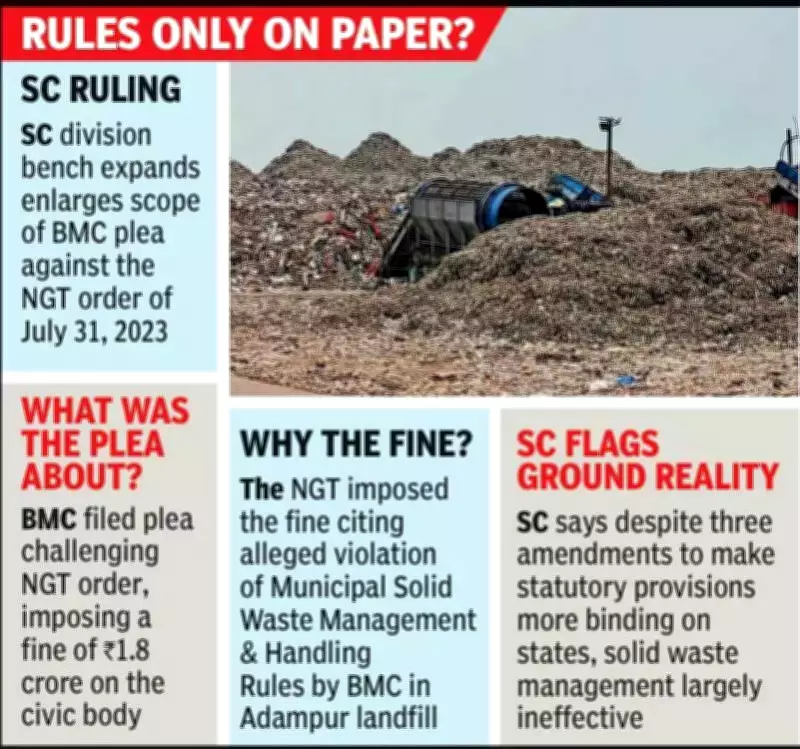
The Supreme Court of India has significantly broadened the scope of a petition filed by the Bhopal Municipal Corporation (BMC) concerning the contentious Adampur landfill site. In a decisive move, the apex court has ordered the inclusion of top officials from both the Union government and the Madhya Pradesh state administration as respondents in the ongoing legal proceedings.
Background of the Case and NGT Fine
The case originated from BMC's appeal challenging a July 31, 2023 order issued by the National Green Tribunal (NGT). The environmental tribunal had imposed a substantial fine of Rs 1.80 crore on the civic body for alleged violations of the Solid Waste Management and Handling Rules at the Adampur landfill facility. This penalty highlighted serious concerns regarding waste management practices in the region.
Supreme Court's Critical Observations on Implementation Failures
During the hearing, the Supreme Court bench, comprising Justice Pankaj Mihal and Justice SVN Bhatti, made pointed observations about the systemic failures in solid waste management across India. The justices remarked that despite numerous statutory rules being introduced and amended over the years—including revisions in 2000 and 2016—these regulations were consistently failing at the ground level.
The bench specifically noted that the recently implemented Solid Waste Management Rules of 2026, which replaced previous amendments, have not altered the challenging reality of ineffective implementation. The court expressed concern that without proper groundwork before enforcement, even updated provisions would struggle to achieve meaningful change.
Expansion of Respondents to Include Senior Officials
In a significant procedural development, the Supreme Court directed the BMC to add three senior officials each from the Union government and the Madhya Pradesh state government as respondents in the petition. This expansion aims to facilitate a comprehensive examination of the reasons behind the persistent lack of effective solid waste management implementation.
The Union government officials to be impleaded as respondents include:
- The Secretary of the Ministry of Environment, Forest and Climate Change
- The Secretary of the Ministry of Housing and Urban Affairs
- The Secretary of the Ministry of Panchayati Raj
From the state government of Madhya Pradesh, the following officials will be added:
- The Chief Secretary
- The Additional Chief Secretary of the Urban Development and Housing Department
- The Principal Secretary of the Housing and Environment Department
Court's Concerns About Ground-Level Implementation
The Supreme Court articulated a clear concern that the statutory mechanism for solid waste management was not yielding the desired results due to multiple factors at the field level. "The court is of the view that the statutory mechanism is not yielding desired results because of several factors at the field level," the bench stated during the proceedings.
While acknowledging that the introduction of new rules represented a positive step, the justices emphasized that authorities must complete essential preparatory work before enforcement deadlines take effect. "Otherwise, the amended provisions under Solid Waste Management Rules, 2026 will not alter the ground reality," the court cautioned, highlighting the gap between policy formulation and practical implementation.
Future Implications and Next Steps
This expansion of the petition's scope represents a strategic move by the Supreme Court to address systemic issues in waste management governance. By involving senior officials from both central and state administrations, the court aims to create accountability mechanisms that transcend municipal boundaries.
The case, which saw arguments presented on February 11, 2026, now moves forward with an expanded respondent list that reflects the interconnected nature of environmental governance in India. This development underscores the judiciary's growing role in ensuring that environmental regulations translate into tangible improvements at the community level, particularly in urban waste management systems that affect public health and environmental quality.