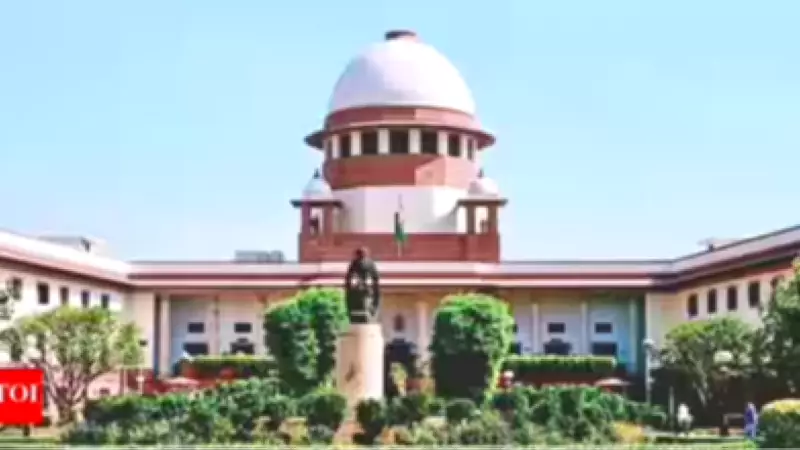
Supreme Court Grants Tamil Nadu Permission to Revise DGP Empanelment Committee
The Supreme Court of India has delivered a significant ruling, permitting the Tamil Nadu government to revise the composition of the empanelment committee responsible for selecting the state's Director General of Police (DGP). This decision comes in response to a unique situation where the current DGP in-charge is also a candidate for the permanent top post, creating a potential conflict of interest.
Court's Directive and Timeline
A bench comprising Chief Justice of India Surya Kant, Justice Joymalya Bagchi, and Justice Vipul M Pancholi issued the order on Thursday, directing the state to add an alternate DGP-rank officer to the committee. The court mandated that Tamil Nadu submit a fresh proposal containing the names of eligible officers for the DGP position and complete this entire exercise within a strict timeline of three weeks. This directive aligns with the Supreme Court's established protocols for the selection and appointment of police chiefs across states.
Background of the Committee and the Conflict
The empanelment committee, as per the Supreme Court's guidelines in the landmark Prakash Singh case, typically includes five members: the chairperson of the Union Public Service Commission (UPSC), the Union home secretary, the state chief secretary, the current state DGP, and an officer from central police organizations not belonging to the state cadre, nominated by the Union home ministry.

Senior advocate P Wilson, representing Tamil Nadu, presented the state's predicament to the court. He explained that the committee was properly constituted but included the current DGP in-charge, Shankar Jiwal Venkataraman, who is also under consideration for the permanent role. To address this, the Tamil Nadu government had formally requested the UPSC on September 17, 2025, to substitute the state home secretary (who holds the rank of additional chief secretary) in place of the DGP. However, the UPSC rejected this request on September 22, 2025.
Legal Arguments and Consensus
Wilson further argued that a new committee should be formed with two representatives from the state government to ensure that Tamil Nadu's interests are adequately protected during the selection process. This stance received support from the court-appointed amicus curiae, senior advocate Raju Ramachandran, who concurred with the state's submissions. The court considered these arguments and the peculiar circumstances before granting relief, emphasizing the need for a fair and unbiased selection process free from any perceived conflicts.
Implications and Next Steps
This ruling underscores the judiciary's role in upholding transparency and fairness in high-level appointments. By allowing the revision, the Supreme Court has provided a pathway for Tamil Nadu to proceed with the DGP appointment while adhering to legal standards. The state must now swiftly reconstitute the committee, include the alternate DGP-rank officer, and compile a list of eligible candidates, ensuring the process is completed within the stipulated three-week period to fill this critical leadership position in the state police force.