In a significant ruling reinforcing the binding nature of government policy, the Supreme Court of India has set aside a Rajasthan government notification that sought to name revenue villages after individuals. The apex court held that the state cannot act in violation of its own circulars, specifically a 2009 policy that prohibits naming villages after persons, religion, or caste.
The Core of the Legal Dispute
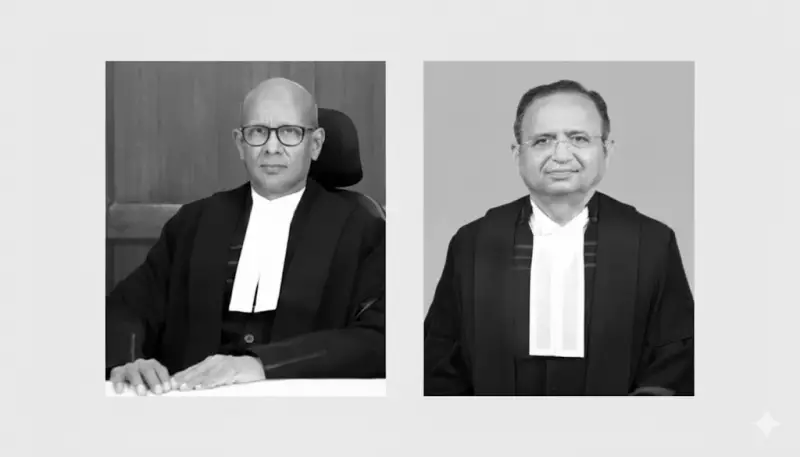
A bench comprising Justices Sanjay Kumar and Alok Aradhe delivered the verdict on December 19, 2025, allowing an appeal by residents of Barmer district in Rajasthan. The residents had challenged a December 2020 notification by the state revenue department that created new revenue villages, including "Amargarh" and "Sagatsar."
The court found that these names were derived from the names of individuals—Amarram and Sagat Singh—who had reportedly donated land. This practice, the court ruled, directly contravened a 2009 circular issued by the very same revenue department. The circular explicitly mandates that the name of a revenue village "shall not be based on any person, religion, caste or sub-caste" and must be proposed with general consensus.

Policy Binds the Government: Supreme Court's Firm Stand
The Supreme Court emphasized a fundamental legal principle: a policy decision, though executive in nature, binds the government. "The state government cannot be permitted to act in contravention of the policy framed by it, which binds it," the bench asserted. It noted that the 2009 circular was formulated with the objective of maintaining communal harmony, giving it significant weight.
The state government, defending its 2020 notification, argued that the 2009 circular was merely "directory" and not mandatory. It also contended that the prescribed statutory procedure under the Rajasthan Land Revenue Act, 1956 was followed and that the residents lacked "locus standi" as the notification caused them no legal injury. However, the apex court rejected these arguments, upholding the policy's binding character.
Journey Through the Courts
The legal battle saw several twists. Initially, a single judge bench of the Rajasthan High Court, in an order dated July 2025, had quashed the 2020 notification. It granted liberty to rename the villages in accordance with the law. However, a division bench of the High Court later set aside this single judge's order.
The aggrieved residents then approached the Supreme Court. The top court, after examining the facts and the law, quashed the division bench's order and restored the single judge's decision. This effectively nullifies the naming of "Amargarh" and "Sagatsar" as revenue villages under the 2020 notification.
The ruling underscores that government authority must be exercised within the framework of its own declared policies, especially those designed to promote social unity. It serves as a reminder that administrative actions, even those undertaken under statutory powers, cannot override established principles aimed at public welfare and harmony.