

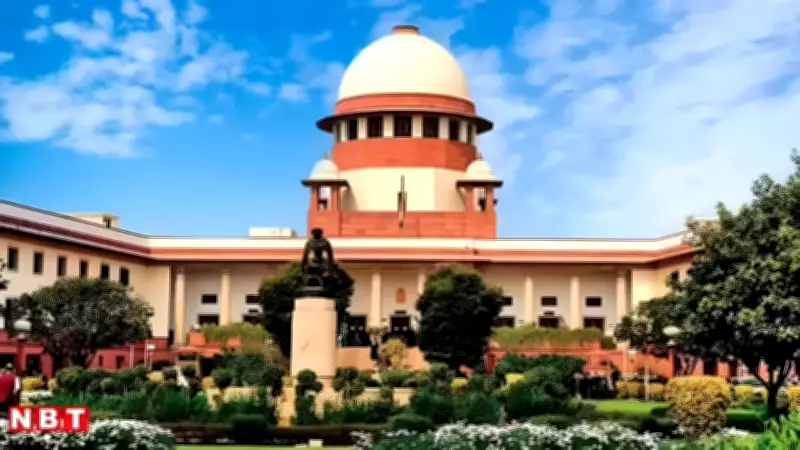
Supreme Court Bench Acknowledges Judicial Limitations in Social and Religious Reform
A nine-judge Supreme Court bench, led by Chief Justice of India Surya Kant, made significant observations on Wednesday regarding the judiciary's role in social and religious reforms. The bench explicitly stated that it would be challenging for the courts to initiate or drive such reforms, highlighting that governments are better equipped to enact laws in response to genuine public demands.
Context of the Remarks During Fundamental Rights Hearings
This crucial acknowledgment of the court's limitations emerged on the seventh day of hearings addressing the complex interplay between fundamental rights and faith. The bench, which includes Justices B V Nagarathna, M M Sundresh, Ahsanuddin Amanullah, Aravind Kumar, A G Masih, P B Varale, R Mahadevan, and J Bagchi, has been deeply engaged in examining these sensitive issues.
The remarks were prompted by senior advocate Gopal Subramanium, who argued before the bench that a devotee's personal faith and belief are non-justiciable. He emphasized that even the government, in the name of social reform, cannot infringe upon the religious rights of a denomination or community.

Detailed Judicial Observations on Reform and Adjudication
Justice Kumar raised pointed questions during the proceedings, asking, "Can the courts adjudicate a dispute over a religious practice between two groups within the same denomination or a temple? What could be the juridical basis for a constitutional court while entertaining a writ petition or a PIL to decide whether one type of religious practice is more desirable?"
Justice Sundresh added to this line of inquiry, noting that apart from the three constitutionally specified grounds—public order, morality, and health—there appears to be no other basis, not even the violation of fundamental rights, to restrict a person's right to freedom of conscience and the right to freely profess, practice, and propagate religion.
The bench collectively articulated that social reforms and religious reforms stem from the will and desire of the people, to which the government responds by introducing legislation. However, the court underscored that it is very difficult for the judiciary to act on such issues directly. Instead, courts can adjudicate the validity of social reform legislation by testing whether it intrudes into the faith or religious beliefs of devotees.
Arguments from Legal Representatives on Religious Rights
Senior advocate C A Sundaram, appearing for the general secretary of Sabarimala Karma Samiti, argued that the constitutional or legal views of the court are immaterial to devotees' conscientiously and genuinely held religious beliefs and practices. He stressed that worshiping God is protected as a fundamental right under Article 25 of the Constitution.
Sundaram further faulted the 2018 judgment for incorrectly applying the equality and non-discrimination test to the religious custom at the Sabarimala Ayyappa temple. He contended that the right to equality primarily applies to government employment and should not be used as a tool to strike down long-standing religious customs that are intrinsically connected to people's beliefs and faith regarding the attributes of the deity.
Echoing a similar sentiment, senior advocate Rakesh Dwivedi advocated for a hands-off approach by the judiciary towards religious matters. He emphasized the need for courts to exercise restraint and avoid overstepping into areas best left to legislative and executive branches, particularly when it comes to deeply held religious practices and traditions.
Implications and Broader Legal Framework
This ongoing hearing marks a pivotal moment in Indian jurisprudence, as the Supreme Court grapples with defining the boundaries of judicial intervention in matters of faith and social change. The bench's reservations and doubts over judicial oversight of religious issues highlight the delicate balance between upholding constitutional rights and respecting religious autonomy.

The discussions underscore a fundamental principle: while the judiciary plays a critical role in safeguarding rights and ensuring justice, its capacity to drive social reform is inherently limited. This recognition aligns with the constitutional separation of powers, where lawmaking is primarily the domain of the legislature, and the executive implements these laws, with the judiciary serving as an interpreter and guardian of the Constitution.
As the hearings continue, the Supreme Court's deliberations are expected to provide clearer guidelines on how courts should approach cases involving religious practices and social reforms, potentially shaping future legal precedents in this complex and sensitive area.





