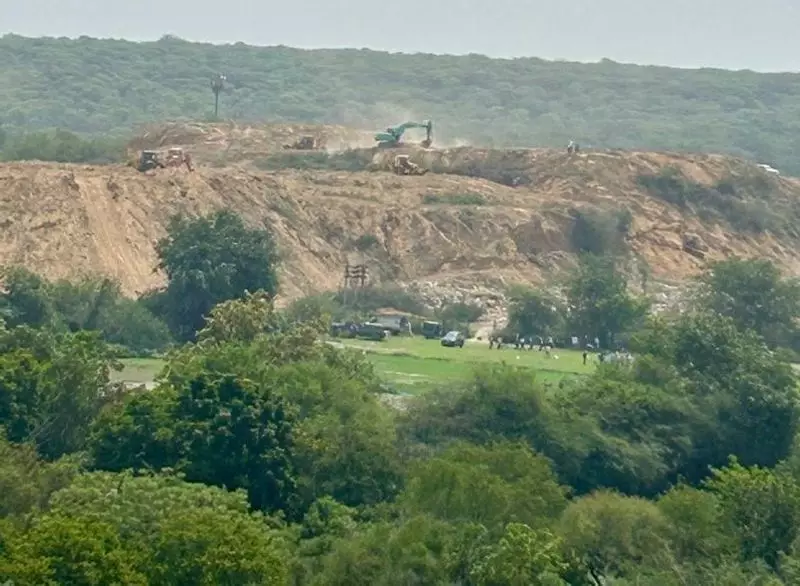
The Supreme Court of India has taken a decisive step to address the ecological crisis surrounding the Aravalli range. In a significant move, the court has called for a fresh expert opinion to clearly define what constitutes the 'Aravalli Hills'. This directive comes amidst growing concerns over environmental degradation and unchecked construction in the ecologically fragile region.
A Bench Seeks Clarity on a Long-Standing Ambiguity
A bench comprising Justices B.R. Gavai and Sandeep Mehta issued this order on Tuesday, April 29, 2024. The court was hearing a crucial matter related to the demarcation and protection of the Aravalli range. The justices expressed dissatisfaction with the existing definitions and the lack of a uniform, scientific basis for identifying the hills.
The bench specifically noted the conflicting reports and interpretations that have plagued conservation efforts for years. It highlighted that different authorities and states have used varying criteria, leading to legal loopholes and environmental harm. The court's intervention aims to settle this ambiguity once and for all, providing a solid foundation for future protection laws and policies.
The Core of the Problem: What Exactly Are the Aravallis?
The central issue revolves around the legal and geographical definition of the Aravalli Hills. This ancient mountain range, stretching across Gujarat, Rajasthan, Haryana, and Delhi, acts as a crucial green barrier against desertification and a major groundwater recharge zone. However, its exact boundaries and constituent parts have been poorly defined in official records.
This vagueness has been exploited, leading to large-scale mining, real estate development, and deforestation in areas that should technically be protected. The Supreme Court's decision to seek a new, comprehensive expert report is a direct response to this regulatory failure. The court wants a panel of independent geological and ecological experts to submit a clear, scientifically-backed report.
The court has given the expert committee four weeks to prepare and submit its findings. This report is expected to outline precise parameters—based on geology, topography, and ecology—to determine which areas qualify as part of the Aravalli range. This definition will have far-reaching implications for land use, mining licenses, and construction approvals across multiple states.
Implications for Conservation and Legal Enforcement
The Supreme Court's order is a potential game-changer for environmental protection in North India. A clear, court-mandated definition will empower regulatory bodies like the Forest Department and state pollution control boards. It will remove the ambiguity that has often stalled enforcement actions against violators.
Environmental activists have long argued that the fuzzy definition has been the biggest hurdle in conserving the Aravallis. A scientific definition will help in:
- Stemming illegal mining and land encroachment.
- Protecting forest cover and wildlife corridors.
- Safeguarding the region's critical water recharge capacity.
- Providing clarity for sustainable urban planning in the National Capital Region (NCR).
The court's proactive stance signals a shift towards evidence-based environmental jurisprudence. By relying on expert opinion, the judiciary is ensuring that its orders are grounded in science, not just legal technicalities. This move is seen as a major victory for civil society groups and citizens who have been fighting to preserve the Aravallis, often called the 'lungs of North India'.
The next hearing in the case is awaited after the submission of the expert committee's report. The outcome will likely set a precedent for how other ecologically sensitive areas in the country are defined and protected by law.