

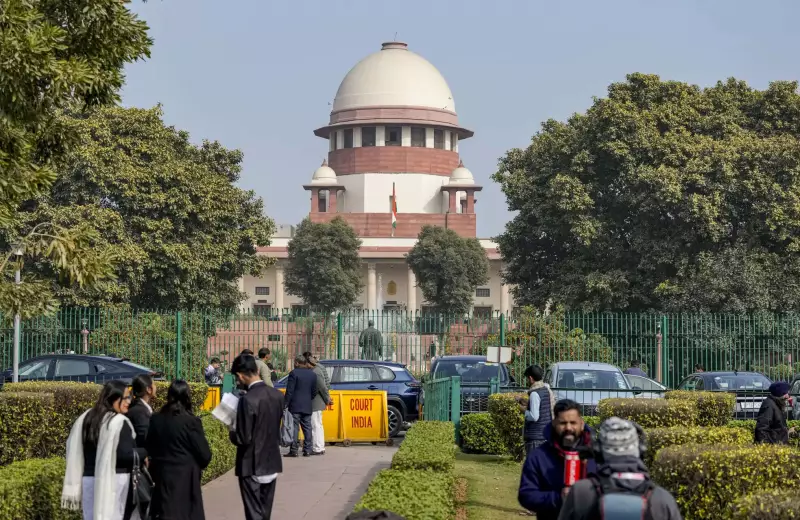
In a significant ruling that underscores a fundamental right, the Supreme Court of India on Tuesday held that the right to a speedy trial is not diminished by the seriousness of the alleged crime. The court granted bail to former Amtek Group chairperson Arvind Dham, who has spent 16 months in jail in a money laundering case, primarily citing the inordinate delay in the commencement of the trial.
Contrasting Bail Outcomes Highlight Legal Principle
This decision presents a stark contrast to the court's order just a day prior, on Monday, where it rejected the bail pleas of activists Umar Khalid and Sharjeel Imam. Both have been incarcerated for nearly six years under the stringent Unlawful Activities (Prevention) Act (UAPA). The Monday bench had ruled that delay and long incarceration alone could not be grounds for bail in their case.
However, the Tuesday bench, comprising Justices Sanjay Kumar and Alok Aradhe, firmly stated that the constitutional guarantee of a speedy trial under Article 21 applies irrespective of the nature of the offence. "The right to speedy trial, enshrined under Article 21 of Constitution, is not eclipsed by the nature of the offence," the bench observed.

Core of the Court's Reasoning in the Dham Case
The court's reasoning for granting bail to Arvind Dham hinged on the practical impossibility of a swift trial. It noted that the proceedings involve the examination of a staggering 210 witnesses, with no likelihood of the trial concluding in the foreseeable future. The evidence in the case is primarily documentary and already in the custody of the prosecution.
"Prolonged incarceration of an undertrial, without commencement or reasonable progress of trial, cannot be countenanced, as it has the effect of converting pre-trial detention into a form of punishment," the bench stated. It added a direct admonition to the state: "If the State... has no wherewithal to provide or protect the fundamental right of an accused to have a speedy trial... then the State... should not oppose the plea for bail on the ground that the crime committed is serious."
Navigating Stringent Bail Laws: UAPA and PMLA
The legal provisions under the UAPA and the Prevention of Money Laundering Act (PMLA) are similarly restrictive regarding bail. Both laws require the court to be satisfied that there are no reasonable grounds to believe the accusation is prima facie true. This creates a high bar for securing release.
However, the Supreme Court has, in multiple precedents, balanced these statutory restrictions against the constitutional right to liberty. The bench referenced past rulings, including cases involving former Delhi CM Arvind Kejriwal and TN minister Senthil Balaji, where long incarceration (ranging from 3 to 17 months) without trial progress was grounds for relief. It also cited the judgment in the case of K.A. Najeeb, where the court held that Section 43D(5) of UAPA does not oust the power of constitutional courts to grant bail on grounds of violated fundamental rights.
Inconsistency or Contextual Application?
The seemingly contradictory orders in the cases of Khalid/Imam and Dham have brought to the fore discussions on consistency in the apex court's approach. Legal experts point out that while the principle of speedy trial is universal, its application is highly fact-specific. The nature of evidence, stage of investigation, specific allegations, and individual judge's interpretation of "prima facie" truth under UAPA/PMLA play a decisive role.
The court in Dham's case clarified that while the gravity of the offence is a factor in bail consideration, statutory restrictions cannot lead to indefinite pre-trial detention in violation of Article 21. This ruling reinforces the judiciary's role as a guardian of fundamental rights, even in cases involving serious economic and national security laws.






