Supreme Court Intervenes in Pawan Khera's Bail Case, Stays Telangana High Court Order
In a significant legal development, the Supreme Court of India on Wednesday issued a stay on the Telangana High Court's order that had granted Congress leader Pawan Khera a one-week transit anticipatory bail. This bail was related to allegations made against Assam Chief Minister Himanta Biswa Sarma's wife, Riniki Bhuyan Sarma. The apex court clarified that Khera retains the right to seek anticipatory bail from the jurisdictional court in Assam, where the First Information Report (FIR) was originally registered.
Assam Government Challenges High Court's Jurisdiction
The Supreme Court's intervention came following an appeal by the Assam government, which contested the Telangana High Court's April 10 order. Representing the Assam Police, Solicitor General Tushar Mehta raised critical objections regarding the maintainability of Khera's plea in Telangana. Mehta emphasized a "patent lack of territorial jurisdiction," arguing that since the FIR was filed in Assam, Khera should have approached courts there for relief.
Mehta further contended that Khera failed to provide a valid explanation for not seeking bail in Assam and did not clearly establish his presence in Telangana. He noted that "merely having some property" in a state does not confer legal jurisdiction, labeling the move as a "complete abuse of process" and an instance of "forum choosing." During the proceedings, Justice Dinesh Maheshwari referenced Khera's claim of his wife's residence in Hyderabad as a basis, but Mehta countered this by pointing out that Khera's Aadhaar records list a Delhi address, and occasional travel or property ownership cannot justify jurisdiction.

Background of the Case and Legal Proceedings
The Telangana High Court had earlier granted Khera limited transit anticipatory bail for one week, observing that his apprehension of arrest appeared "reasonable and supported by material on record." The court imposed conditions such as cooperation with the investigation and refraining from public statements that could prejudice the probe. However, the Assam government challenged this, asserting that Khera did not demonstrate any compelling reason to bypass courts in Assam.
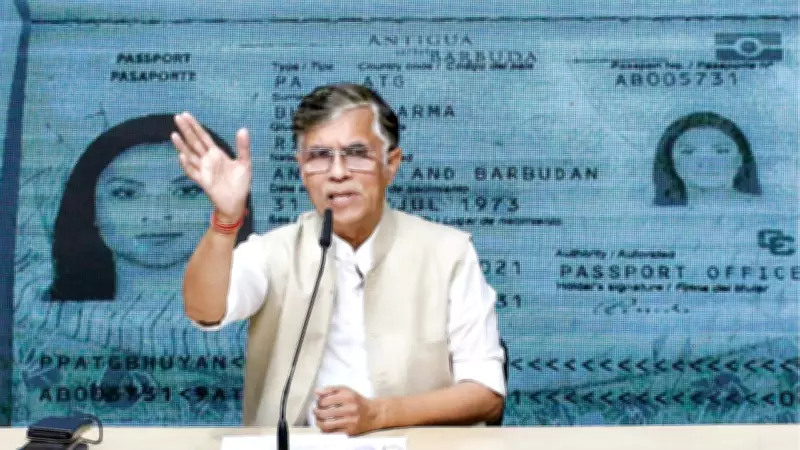
The FIR, registered at the Guwahati Crime Branch Police Station, stems from Khera's allegations on April 5 that Riniki Bhuyan Sarma possessed multiple foreign passports and undeclared overseas assets. The Sarma family has dismissed these claims as "false and fabricated." The case is filed under provisions of the Bharatiya Nyaya Sanhita, including sections related to making false statements in connection with elections and cheating.
This legal battle highlights ongoing tensions in Indian politics and underscores the importance of jurisdictional propriety in legal proceedings. The Supreme Court's decision reinforces the principle that bail applications should be filed in the appropriate territorial courts, ensuring a fair and orderly judicial process.