

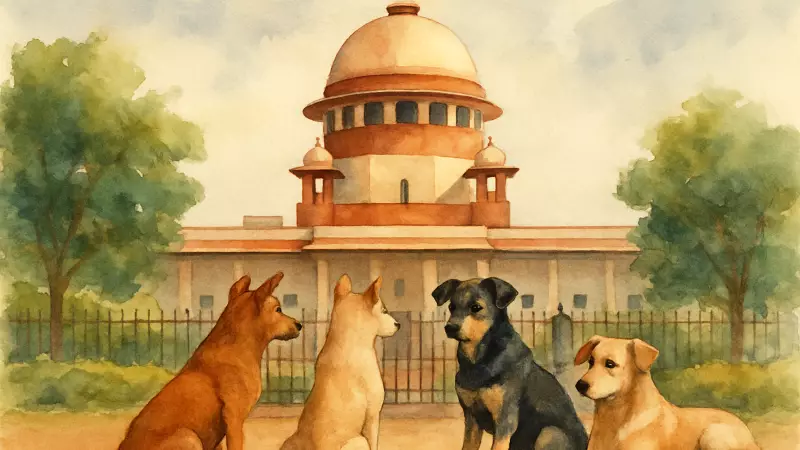
A recent series of orders from the Supreme Court of India regarding the management of stray dogs has ignited a fierce debate, transcending the issue of animal welfare and veering into the territory of a potential constitutional crisis. Legal experts and observers are alarmed by what they perceive as a departure from established law, scientific consensus, and procedural fairness.
An Order Shrouded in Practical and Legal Ambiguity
On November 7, 2025, the Supreme Court issued a directive mandating that all stray dogs on "institutional land" must be picked up by municipal authorities and relocated to shelters. This order, however, was passed without addressing a litany of critical logistical questions. The bench remained silent on the definition of "institutional land," the source of funding for building and maintaining these shelters, the provision of food and medical care for lakhs of confined dogs, and the scientific validity of such mass impounding.
More importantly, the order appears to directly contravene the existing legal framework. The management of stray dogs in India is governed by the Prevention of Cruelty to Animals Act, 1960, and the Animal Birth Control (ABC) Rules, 2023. These laws, read together, explicitly mandate the CNVR (Catch, Neuter, Vaccinate, and Release) method. This is also the scientifically endorsed approach recommended by the World Health Organization (WHO) and followed by numerous developed nations.

The Supreme Court itself had previously upheld this very framework. In the All-India Stray Dogs judgment of May 9, 2024, the apex court upheld the constitutional validity of the PCA Act and the ABC Rules. Prior to that, in orders passed in 2015 and 2016, the Court had reiterated that stray dogs must be sterilized, vaccinated, and released back to their original locations.
Disregarding Statute and Science: A Dangerous Precedent?
The current proceedings, initiated by a suo motu order on August 11, 2025, have taken a starkly different turn. Legal commentators argue that by ordering relocation, the Court is effectively ignoring a statute that squarely occupies the field. Judges are bound by the laws enacted by Parliament, and the Supreme Court cannot function as a law unto itself.
If the Court wished to mandate relocation, the legally sound first step would have been to strike down the existing PCA Act and ABC Rules as unconstitutional. However, the constitutional validity of these laws is not even under challenge in the present suo motu proceedings. This raises profound questions about the limits of judicial power, even under the plenary jurisdiction of Article 142 to do "complete justice."
The justification of an "emergency" to bypass statutory law has drawn particularly sharp criticism. Observers have pointed to historical parallels where the abandonment of laws in the name of emergency powers led to severe consequences, a cautionary note against setting a dangerous precedent.
A Denial of Hearing Amidst a "Pay to be Heard" Condition
Adding to the controversy are serious procedural irregularities. The sweeping relocation order of November 7 was passed without hearing the parties involved, despite vehement requests from counsels present in court. The matter was listed for an urgent hearing on December 18, 2025, only to be suddenly deleted from the cause list the previous night. All subsequent entreaties were dismissed, with the next hearing date pushed to January 7, 2026.
This denial of a hearing is rendered more ironic by an earlier order. On August 22, 2025, the Supreme Court had demanded that NGOs appearing for stray dogs deposit ₹2 lakh as a fee to be heard in the matter. Thus, despite introducing a de facto "pay to be heard" condition on the fundamental right to access courts, the Court has yet to actually hear these parties.

The cumulative effect of these actions—disregarding parliamentary law, ignoring global scientific consensus, and denying a fair hearing—compels a fundamental question: What remains of the "supreme" in the Supreme Court when it appears to not follow the very laws it is sworn to uphold? The stray dogs issue has undeniably escalated into a full-blown debate on judicial overreach and constitutional propriety.





