
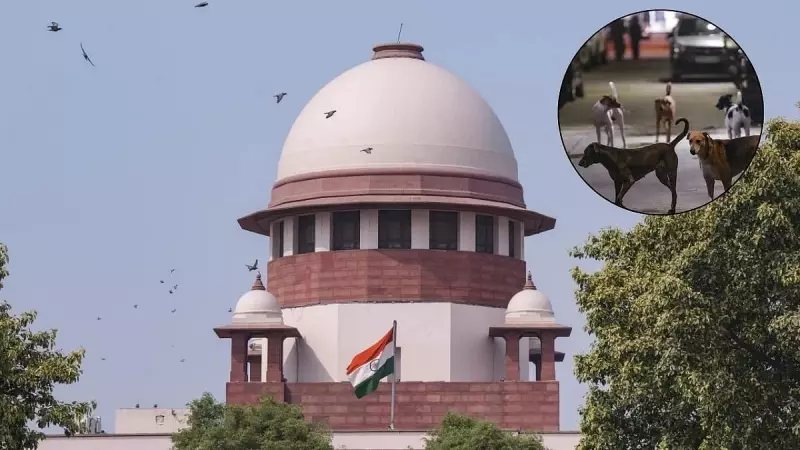
The Supreme Court of India has delivered a significant ruling emphasizing the fundamental duty of municipal authorities and citizens to ensure that public roads and streets are kept free of stray dogs. The apex court made these observations while hearing a plea related to the menace of stray canines, firmly stating that no one can read a dog's mind to predict its behavior.
The Core of the Supreme Court's Observation
A bench comprising Justices Surya Kant and KV Viswanathan was hearing an appeal against a Kerala High Court order. The High Court had directed the Kozhikode Municipal Corporation to take immediate steps to remove stray dogs from public spaces following a series of incidents. The Supreme Court, while acknowledging the concerns, underscored a critical point about animal behavior.
The bench remarked that it is impossible for anyone to ascertain the state of mind of a stray dog. Since its intentions cannot be deciphered, the primary obligation is to protect public safety. The streets and roads have to be free of canines, the court asserted, highlighting this as a non-negotiable aspect of civic management.
Balancing Animal Welfare and Public Safety
The court's ruling does not exist in a vacuum but interacts with existing legal frameworks for animal welfare. The judges specifically referenced the Animal Birth Control (ABC) Rules, 2023. These rules, formulated under the Prevention of Cruelty to Animals Act, 1960, provide a structured protocol for managing stray dog populations through sterilization and vaccination, followed by release in the same area.
The Supreme Court clarified that its directive for keeping streets free of dogs must be read in conjunction with these ABC Rules. It implies that the removal of dogs from public thoroughfares should be carried out humanely as part of a systematic management program, not through culling or indiscriminate relocation. The municipal bodies have a dual responsibility: to implement the ABC program effectively and to ensure public areas are safe for pedestrians, especially children and the elderly.
Implications for Municipal Corporations and Local Bodies
This judgment places a clear onus on local civic authorities across India. The court pointed out that the Kozhikode Municipal Corporation has a statutory duty to ensure streets are not compromised by the presence of stray dogs. This principle extends to all municipal corporations, nagar palikas, and local governing bodies nationwide.
The ruling empowers residents to demand action from their local municipalities. It reinforces that managing stray animals is not merely an act of charity but a core civic function essential for public health and safety. Authorities are expected to allocate sufficient resources and develop proactive strategies for ABC program implementation and vigilant monitoring of public spaces.
The Supreme Court has scheduled the matter for further hearing in July 2024. This indicates the court's intent to monitor the issue closely and ensure its directions are followed in letter and spirit. The upcoming proceedings will likely delve into the practical challenges of implementation and the measurable outcomes expected from municipal bodies.
This verdict strikes a nuanced balance. It firmly prioritizes human safety in public domains while operating within the legal framework of animal protection laws. It sends a unambiguous message to local governments to act decisively and systematically, leaving no room for ambiguity in their duty to maintain safe, accessible public roads for all citizens.