Supreme Court Declines to Intervene in Madurai Hill Religious Dispute
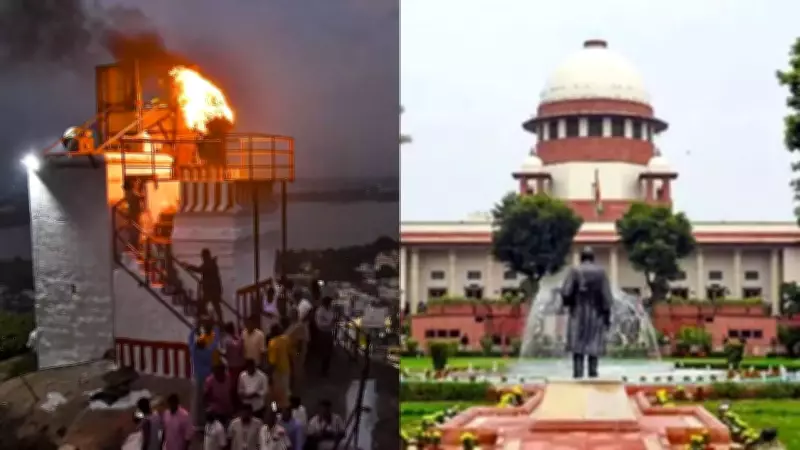
In a significant ruling concerning long-standing religious practices on the Thiruparankundram hill in Madurai, the Supreme Court on Monday refused to interfere with a Madras High Court judgment. The High Court had permitted the lighting of the Karthigai Deepam at a hilltop stone pillar while restricting Muslim prayers at a nearby site to only during the festivals of Ramzan and Bakri-Id.
High Court's Balanced Order Upheld
The Madras High Court had previously held that Muslims have no right to conduct prayers at the Nellithoppu site except during the specified festivals. This land, measuring 33 cents, is owned by the Sikkandar Badhusha Avuliya Dargah. Additionally, the court ruled that animal sacrifice cannot be permitted in the area.
Challenging this verdict, M. Imam Hussain, a worshipper at the Dargah, approached the apex court. A bench comprising Justice Aravind Kumar and Justice PB Varale declined to intervene, describing the High Court order as balanced. Appearing for the petitioner, Advocate Prashant Bhushan argued that there has never been a law and order problem in the area.

Justice Kumar responded that had there been no law and order issue, there would not have been a meeting of the Peace Committee. "It seems to be a very very balanced order," Justice Kumar said, with Justice Varale agreeing, according to reports from Live Law.
"We do not propose to interfere with the order. Without expressing any opinion on rights of the parties, the impugned order stands upheld," the bench observed.
Background of the Legal Proceedings
The ruling stems from proceedings before the Madurai Bench of the Madras High Court, which had upheld a single judge’s order. This order permitted the Thiruparankundram Murugan Temple management to light the Karthigai Deepam at the Deepathoon, a stone pillar located on one of the peaks of the Thiruparankundram hill.
A division bench confirmed the earlier ruling of Justice GR Swaminathan, directing that the ceremonial lamp be lit at the Deepathoon in addition to other customary locations during the festival. The High Court observed that the district administration ought to have treated the issue as an opportunity to bridge the gap between communities through mediation.
It further held that since the hill is a protected site, any activity carried out there must strictly comply with the provisions of the relevant law. The court clarified that the lamp may be lit, and the number of persons permitted can be fixed, subject to consultation with the Archaeological Survey of India. With this, the court cleared the way for continuation of the practice, dismissing objections raised against lighting the lamp at the hilltop stone pillar.
Understanding the Deepam Row
Thiruparankundram hill, rising at the edge of Madurai, carries a layered religious history spanning more than two millennia. Revered as one of the six abodes of Lord Murugan, it houses the ancient Subramaniya Swamy Temple and has references in Sangam-era literature. Archaeological traces reveal Jain presence dating back over 2,300 years.
By the 14th century, the hill also became associated with Sikandar Shah, whose memorial evolved into the Sikkandar Badusha Dargah. For generations, temple festivals and dargah observances unfolded in proximity, with local residents describing shared rituals and overlapping traditions rather than rigid divisions.
The current dispute centres on where the Karthigai Deepam should be lit during the annual festival. Historically, the lamp was lit at the Uchipillaiyar mandapam. Petitions beginning in the 1990s sought to shift the lighting to the hilltop Deepathoon pillar. Courts had earlier declined to alter established practice.
However, a fresh petition in 2024 argued that the 1920s Privy Council decree recognising temple ownership of the hill permitted lighting at the pillar. Justice G R Swaminathan allowed the hilltop lighting, triggering administrative resistance on law and order grounds and eventually escalating into a political flashpoint between the ruling DMK and the BJP, before reaching the Supreme Court.