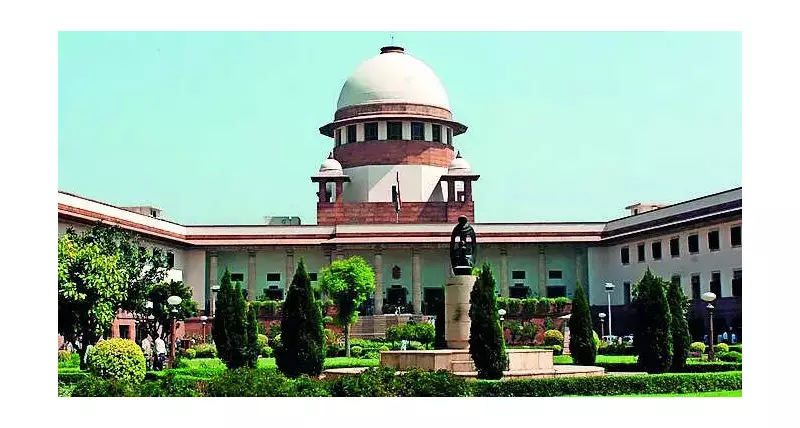
In a significant ruling that underscores the primacy of a testator's wishes, the Supreme Court of India has overturned the decisions of two lower courts to deny a daughter her share in her father's property. The apex court upheld a will that explicitly disinherited Shyla Joseph because she married outside her community.
The Core of the Legal Dispute
The case revolved around the property of N S Sreedharan, who passed away leaving behind nine children. In his last will and testament, Sreedharan excluded his daughter, Shyla Joseph, from inheriting any portion of his assets. The stated reason for this exclusion was her marriage to a person from outside their community.
Shyla Joseph challenged this will in court, seeking an equitable partition of her father's estate. Both the trial court and the Kerala High Court had earlier ruled in her favour. These courts expressed doubt about the validity of the will and ordered that the property be divided equally among all nine siblings, granting Shyla her rightful 1/9th share.

Supreme Court's Decisive Reversal
A Supreme Court bench comprising Justices Ahsanuddin Amanullah and K Vinod Chandran took a starkly different view. The bench allowed the appeal filed by Shyla's siblings and set aside the judgments of the lower courts. Justice K Vinod Chandran, who authored the judgment, stated unequivocally that the will was proved beyond doubt.
"There can be no interference to the will which stands proved unequivocally. The judgment and decree of the high court and that of the trial court stands set aside," the court declared. It concluded that the plaintiff, Shyla Joseph, had no claim over her father's properties, which were legally bequeathed to her other siblings through the will.
Wish of the Testator Overrides Equity
During the proceedings, Shyla's senior advocate, P B Krishnan, argued that her entitlement was merely a negligible 1/9th share of the total assets. However, the bench firmly stated that the question of equality does not arise in matters of inheritance dictated by a valid will.
The court emphasized that it was not adjudicating on principles of equity. "We are not on equity, and the wish of the testator assumes pre-eminence. The last will and testament of the testator cannot be digressed from or frustrated," the bench observed. It clarified that an individual holds absolute discretion to divide his properties as he sees fit, and the courts cannot substitute their opinions for the justifications of the testator.
The bench drew a clear distinction, noting that the "rule of prudence"—which might allow courts to examine a will more critically—would apply only if all siblings had been disinherited. Since only one child was excluded for a stated reason, however unacceptable it may seem to others, the will must stand.
"We cannot put the testator in our shoes... We cannot substitute our opinions in place of that of the testator; his desire prompted by his own justifications," the Supreme Court stated, while dismissing Shyla Joseph's suit for partition.
Implications of the Judgment
This ruling delivers a powerful message about the limits of judicial intervention in testamentary matters. It reinforces the legal principle that a duly executed will represents the final and binding wish of the property owner, provided it is proven valid. The judgment highlights that societal notions of fairness or equality cannot override the clear intent of a testator, even when that intent appears discriminatory based on personal choices like marriage.
The decision marks a pivotal moment in Indian succession law, demonstrating that landmark judgments on gender equality in other spheres do not automatically translate into overturning personal testamentary freedom. The court's role is to interpret the will, not rewrite it based on contemporary values of equity, unless the document itself is proven fraudulent or illegal in its creation.