

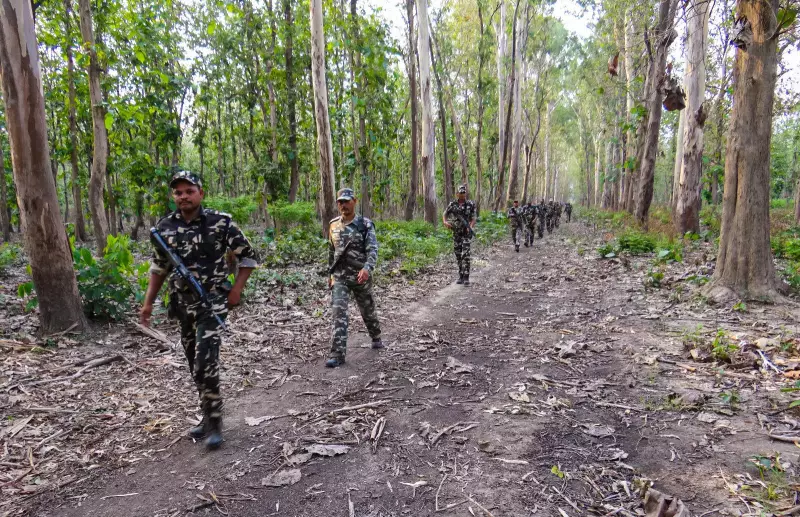
Indian security agencies have raised a major alarm over escalating security threats along the country's open border with Nepal. The historically porous frontier is witnessing a dangerous surge in illegal infiltration using forged documents, alongside rampant narcotics and contraband smuggling. In response, the Union Home Ministry has mandated stringent new measures, designating all sensitive stretches as high-security zones with 24/7 patrols.
Foreign Nationals Nabbed, Bangladeshi Infiltration Uncovered
The vulnerabilities of the border were starkly highlighted through recent interceptions by the Sashastra Seema Bal (SSB). During 2025, SSB personnel arrested 16 foreign nationals from countries including the United States, China, Canada, Korea, Nigeria, Sudan, and the UAE. These individuals were apprehended at the Raxaul immigration checkpost in Bihar while attempting to enter India without valid documents. Officials stated they failed to provide a clear purpose for their visit and are currently held in Motihari central jail.
A more concerning pattern emerged on January 1, 2026, when three Bangladeshi nationals were arrested at the Raxaul checkpost gate. They were trying to enter India with forged Indian visas, aided by an Indian middleman. Identified as Shahinur Rahman (Jashore), Mohammad Sabuj (Bhola), and Mohammad Firoz Mathbari (Bagerhat), the trio had been long-term residents of Nepal and planned to travel to Chennai. Security agencies revealed they could not explain their Chennai visit purpose and had alleged links to an Islamic organization based there.

This incident underscores a broader trend. Agencies report that a significant number of Bangladeshi nationals have taken shelter in Nepal's border areas, using the open frontier as a conduit to enter India illegally.
Narcotics Trade and Terrorist Activity Pose Grave Threats
Beyond human trafficking, the border has become a hotbed for narcotics smuggling. Officials report a sharp increase in the trafficking of drugs like charas, heroin, ganja, opium, and chemical substances, with interstate networks growing bolder. The SSB and police have seized narcotics worth approximately Rs 39 crore in the international market from this corridor, pointing to the scale of the operation.
The region's security challenges are compounded by its history of being used as a safe haven for terrorists. The SSB and police sources confirm that several senior terrorists involved in anti-national activities have been arrested here. Notable arrests include Indian Mujahideen chief Yasin Bhatkal and associate Asadullah Akhtar in 2013, and two senior SIMI members, Md Quraishi and Md Aziz, in 2018 near Raxaul.
In a more recent scare, three Pakistan-based Jaish-e-Mohammad terrorists were spotted at Raxaul in 2025 but escaped after a hot chase. The same year saw the arrest of Harprit Singh, a Canadian national linked to the Khalistani movement, at the same border point.
Government Response and High-Level Security Review
The gravity of the situation prompted a high-level review. Union Minister of State for Home Affairs, Nityanand Rai, inspected the India-Nepal border at Raxaul on December 13 last year during the SSB's 62nd foundation day. He held detailed discussions with senior officials from customs, SSB, and other agencies, directing them to intensify monitoring.
Rai reiterated that sensitive areas are now official high-security zones. He also contextualized the challenge, noting that India and Nepal share an open border of about 1,800km across five Indian states, governed by the 1950 Treaty of Peace and Friendship. This very openness, while a symbol of friendship, now requires robust and vigilant security mechanisms to prevent exploitation by criminals, traffickers, and terrorists.
The coordinated efforts of the SSB, state police, and central agencies like the NIA are now focused on creating an impenetrable shield along this vital frontier, balancing the historic open-border policy with the imperative of national security.






