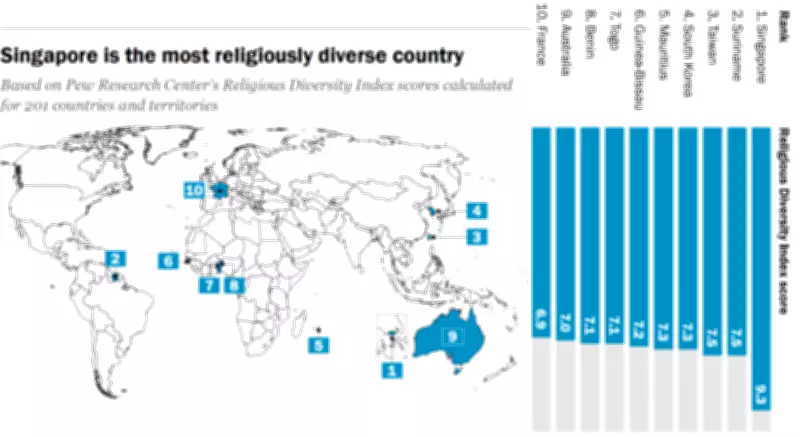
Singapore Emerges as World's Most Religiously Diverse Nation in Global Study
A groundbreaking study by the Pew Research Center has identified Singapore as the planet's most religiously diverse country, highlighting how its population is remarkably evenly distributed across seven major faith categories. This comprehensive analysis of 201 nations and territories captures significant global religious transformations occurring between 2010 and 2020.
Global Religious Landscape Undergoes Dramatic Shifts
The findings reveal profound changes in worldwide religious demographics. Christians maintain their position as the largest religious group with 2.3 billion adherents, yet their share of the global population has slightly decreased. Muslims represent the fastest-growing major religion, expanding by an impressive 347 million over the past decade. Hindus increased by 126 million to reach 1.2 billion, maintaining a steady 14.9% of the world's population.
Meanwhile, the religiously unaffiliated category now constitutes 24.2% of the global population, making it the third-largest group worldwide. Buddhists stand out as the only major faith to experience a decline in absolute numbers during this period.

Understanding the Religious Diversity Index Methodology
The study employs a sophisticated Religious Diversity Index (RDI) that scores countries on a scale from 0 to 10. A score of 0 indicates complete religious homogeneity, while a perfect 10 would represent an entirely even distribution across seven categories: Christians, Muslims, Hindus, Buddhists, Jews, adherents of other religions, and people with no religious affiliation. No nation achieved a perfect score, but Singapore came remarkably close.
This ranking system relies on demographic estimates from Pew's 2025 report, which synthesized data from more than 2,700 censuses and surveys. The analysis encompasses 201 countries and territories that collectively accounted for 99.98% of the global population in 2020.
Singapore's Exceptional Religious Diversity Profile
With an RDI score of 9.3, Singapore demonstrates near-perfect religious diversity. Buddhists constitute 31% of the population, forming the largest single group. They are followed closely by religiously unaffiliated residents at 20%, Christians at 19%, Muslims at 16%, Hindus at 5%, and adherents of other religions at 9%. Crucially, no single religious group holds a majority position in Singapore's diverse society.
Suriname ranks second globally and represents the only Latin American country in the top ten. Its population distribution reflects historical patterns, with 53% Christian, 22% Hindu, 13% Muslim, and 8% religiously unaffiliated, partly shaped by descendants of 19th-century indentured laborers from British India.
Regional Patterns in Religious Diversity
The Asia-Pacific region emerges as the most religiously diverse overall, boasting an RDI score of 8.7. No single religious group forms a majority in this vast region, where religiously unaffiliated people represent approximately one-third of the population. The area includes substantial populations of Muslims, Hindus, Buddhists, Christians, and adherents of various other religions.
At the opposite extreme, Yemen, Afghanistan, and Somalia rank among the least religiously diverse nations. In each of these countries, Muslims account for 99.8% or more of the population. The Middle East and North Africa region records the lowest diversity score at 1.3, with 94% of its population identifying as Muslim.
Detailed Analysis of Global Religious Changes
The study provides granular insights into how religious affiliations evolved between 2010 and 2020:

- Christians: Increased by 122 million to 2.3 billion but declined as a percentage of global population from 30.6% to 28.8%
- Muslims: Grew by 347 million to reach 25.6% of global population, representing the fastest growth of any major religion
- Religiously Unaffiliated: Expanded by 270 million to 1.9 billion, now constituting 24.2% of world population
- Hindus: Increased by 126 million to 1.2 billion while maintaining 14.9% global share
- Buddhists: Declined by 19 million to 324 million, dropping to 4.1% of global population
- Jews: Grew by nearly 1 million to 14.8 million, remaining approximately 0.2% of world population
Diversity Among the World's Most Populous Nations
Among the ten most populous countries, which collectively account for nearly 60% of humanity, the United States demonstrates the greatest religious diversity. Christians comprise 64% of the American population, while religiously unaffiliated people account for about 30%. The remaining 6% includes Muslims, Hindus, Buddhists, Jews, and adherents of other religions.
Nigeria ranks as the second-most diverse among these large nations, with Muslims and Christians each comprising more than 40% of its population. In stark contrast, Pakistan emerges as the least diverse among the ten, with Muslims accounting for 97% of its population.
Research Methodology and Funding Sources
These comprehensive findings originate from a Pew Research Center report released in February 2026 as part of the Pew-Templeton Global Religious Futures project. The initiative received funding from The Pew Charitable Trusts, the John Templeton Foundation, and Templeton Religion Trust. The research represents one of the most thorough examinations of global religious demographics ever conducted, providing valuable insights into how belief systems are evolving worldwide.