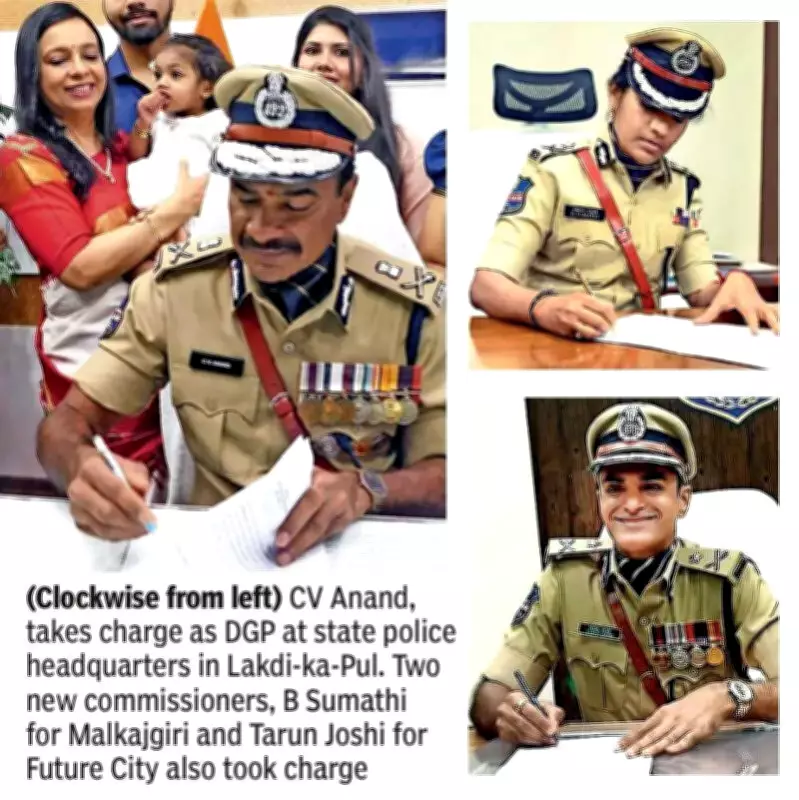
Hyderabad: Telangana Director General of Police (DGP) CV Anand has stated that the investigation into the phone-tapping case is nearly complete and that a second chargesheet will be filed shortly. After assuming charge as DGP on Friday, Anand also announced the creation of a new Traffic Management and Road Safety Bureau aimed at reducing road accident fatalities.
Phone-Tapping Case Progress
Responding to queries about the phone-tapping case, Anand said the investigation would conclude soon. "It appears that the investigation is almost over. I will review the status of the case and ensure that a second chargesheet is filed soon," he stated. In June 2024, the police filed the first chargesheet against six accused, including former SIB chief Prabhakar Rao; Deputy SP D Praneeth Rao; Additional Superintendents N Bhujanga Rao and M Thirupathanna; former Task Force DCP P Radha Kishan Rao; and A Shravan Kumar, Managing Director of a media channel. Subsequently, investigators issued notices and recorded statements from individuals whose phones were tapped. BRS top leaders, including former Chief Minister K Chandrasekhar Rao, former ministers Harish Rao and KTR, and Prabhakar Rao, who had returned from the USA, were all questioned.
New Traffic Management and Road Safety Bureau
Anand emphasized that road safety and traffic management are among his top priorities. To reduce road accident fatalities, a new bureau with statewide jurisdiction will soon be created, modeled after the TG Cyber Security Bureau (TGCSB) and the Elite Action Group for Drug Law Enforcement (EAGLE). Highlighting the scale of the challenge, Anand noted that around 7,500 people die in road accidents in the state every year. He also pointed to the rapid rise in vehicle numbers, with about 1,600 new vehicles added to the roads daily in the four city commissionerates, while road infrastructure is not expanding at the same pace. He observed that enforcement of traffic rules remains uneven, with stricter implementation of helmet and seat belt rules in Hyderabad than in other parts of the state. The new bureau, he said, would ensure uniform enforcement and keep footpaths and carriageways free from encroachments by hawkers.

Women's Safety and Child Trafficking
On women's safety and child trafficking, the DGP said trafficking has emerged as an organized crime requiring closer scrutiny. He added that the police would intensify their focus on trafficking gangs as well as other offenses such as gambling, food adulteration, and smuggling. Anand also called on officers to act swiftly on field intelligence to prevent situations from escalating.
Use of Technology in Policing
Anand stated that Artificial Intelligence (AI) would be used in traffic management, while the use of drones would be explored for traffic regulation and disaster management. He also noted that only 32% of the state's six lakh CCTV cameras are functional. Restoring them has been made a priority, as CCTV footage has become crucial in solving crimes.
Redeployment of Personnel
Anand said the police force would be reorganized by shifting personnel from low-workload units to departments facing shortages. Anti-Naxal units such as Greyhounds and the Special Intelligence Bureau could see redeployment, as Maoist activity has sharply declined following surrenders and encounters. He noted that the Anti-Corruption Bureau, Vigilance and Enforcement Department, and the CID require additional manpower. Telangana police currently have about 19,000 vacancies, he said. He added that cordon-and-search operations would be conducted whenever necessary. While appealing to the small number of Maoists yet to surrender to join the mainstream, Anand said rehabilitation and monitoring of surrendered Maoists would continue to ensure such activity does not re-emerge.
Coordination with Specialized Units
Anand further said that district superintendents of police and their teams must work closely with specialized units such as the TGCSB and EAGLE to strengthen the state's response to cyber offenses and the drug menace. These specialized agencies, which operate a limited number of police stations directly under them across the state, would require stronger coordination with district police to deliver meaningful results.