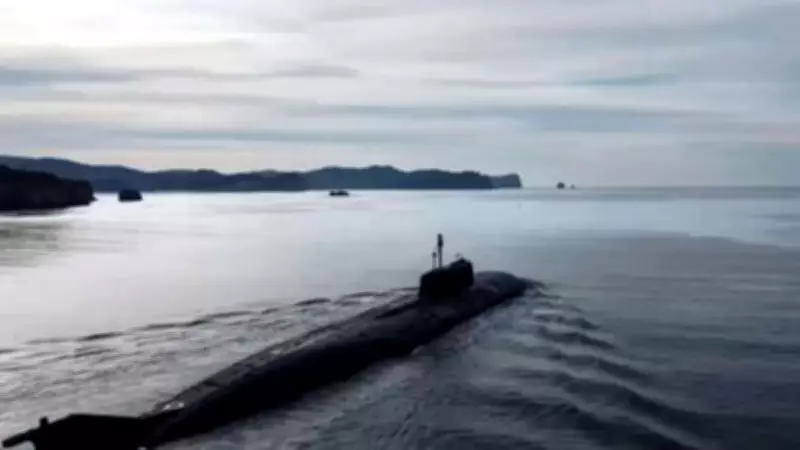
UK Issues Stern Warning to Russia Over Covert Submarine Activity Near Undersea Cables
The United Kingdom has issued a powerful and unequivocal warning to Russia following the detection of what British authorities describe as a covert submarine operation targeting vital undersea cables and pipelines in the North Atlantic region. Defence Secretary John Healey revealed that British military forces had successfully tracked multiple Russian vessels operating suspiciously near sensitive underwater infrastructure.
Clear Message to Moscow from Defence Secretary
Addressing Russian President Vladimir Putin directly during a press briefing, Healey delivered a stern message: "We see your activity over our cables and our pipelines, and you should know that any attempt to damage them will not be tolerated and will have serious consequences." The Defence Secretary emphasized that British forces had been monitoring the situation closely and would respond decisively to any hostile actions.
According to detailed intelligence reports from UK officials, the suspicious activity involved an Akula-class nuclear-powered attack submarine accompanied by two specialized deep-sea vessels believed to be part of Russia's sophisticated underwater surveillance program. The operation unfolded in strategic waters north of the United Kingdom, where critical infrastructure is concentrated.

UK Forces Launch Comprehensive Surveillance Operation
In response to the detected threat, the Royal Navy and Royal Air Force immediately launched a coordinated monitoring mission of unprecedented scale. A Type 23 frigate, multiple support vessels, and maritime patrol aircraft were deployed alongside allied forces to track the Russian submarines continuously around the clock.
British military personnel employed advanced surveillance measures including sophisticated sonar buoys and cutting-edge tracking technology to ensure the Russian vessels remained under constant observation. Officials confirmed that the visible presence of UK military assets made it abundantly clear to Moscow that their covert operation had been completely detected and was no longer secret.
Intelligence analysis suggests the Akula-class attack submarine likely served as a decoy, eventually retreating from the area, while the two specialized submarines remained longer near key infrastructure before also withdrawing from the monitored zone.
Critical Infrastructure Under Threat
The United Kingdom relies heavily on undersea networks for both communication and energy transmission. More than 90 percent of the nation's internet traffic flows through submarine cables, while a significant portion of its natural gas supply arrives via pipelines from Norway beneath the North Sea.
Globally, hundreds of thousands of miles of undersea cables carry essential data and electricity between continents, making them crucial yet vulnerable components of modern infrastructure. Any disruption to these systems could have catastrophic consequences for economies, communications, and energy security worldwide.
Concerns Over Hybrid Warfare Tactics
British officials have linked this incident to broader concerns about what they term hybrid warfare tactics, where hostile states conduct deniable operations below the threshold of open conflict. Such activities often target critical infrastructure to exert political and economic pressure without triggering direct military confrontation.
Healey suggested the timing of the Russian operation may have been deliberately calculated, with Moscow attempting to exploit global distractions including the ongoing conflict in the Middle East. The Defence Secretary emphasized that the UK remains vigilant against such covert threats to national and international security.
The incident highlights growing tensions between Western nations and Russia over underwater infrastructure security, with the UK taking a firm stance against what it perceives as provocative and potentially dangerous military activities in strategically important maritime zones.