

Mob Storms US Consulate in Karachi Following Fatal Airstrike on Iran's Leader
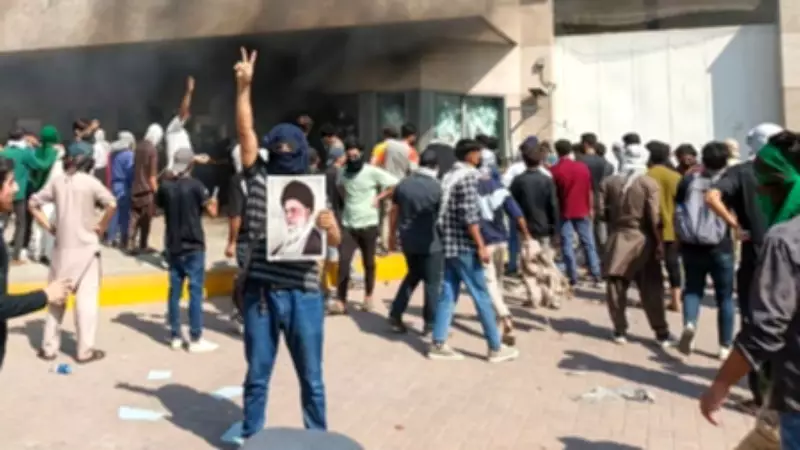
A violent mob comprising hundreds of individuals stormed the United States consulate in Karachi, Pakistan, on Sunday. This aggressive act came in direct response to a joint military operation conducted by the United States and Israel, which resulted in the death of Iran's Supreme Leader, Ayatollah Ali Khamenei. The protesters engaged in widespread vandalism, damaging property and setting sections of the consulate building ablaze, as tensions escalated rapidly across the region.
Casualties and Police Response Amidst Chaos
According to reports from the Associated Press, the confrontation turned deadly when police and paramilitary forces intervened to disperse the crowd. They utilized batons and tear gas, leading to the tragic death of at least one protester and leaving several others wounded. The situation prompted immediate action from local authorities, with Sindh Home Minister Ziaul Hassan Lanjar demanding a swift report on the incident from Karachi Additional Inspector General of Police Azad Khan.
Traffic Disruptions and Ongoing Monitoring
The unrest caused significant disruptions to daily life in Karachi, a major port city. Karachi Traffic Police issued an update around 11 a.m., announcing the closure of both sides of the road from Sultanabad Traffic Section towards Mai Kolachi due to the protest, as reported by Dawn. Authorities continued to closely monitor the volatile situation, with tensions remaining high following the developments linked to the Iranian leader's killing.

Background: Operation Epic Fury and Iran's Retaliation
This violent protest erupted hours after Iran officially confirmed that Ayatollah Ali Khamenei was killed in airstrikes carried out by Israel and the United States, an operation dubbed Operation Epic Fury. Iran acknowledged the 86-year-old leader's death at his office in Tehran, a momentous event that has thrown the future of the Islamic Republic into uncertainty and heightened risks of regional instability. In retaliation, Iran launched missile strikes at targets in Israel and Gulf Arab states on Sunday, vowing massive revenge for Khamenei's assassination.
Iran's Cabinet issued a stern warning, stating that the great crime will never go unanswered, while the paramilitary Revolutionary Guard threatened to initiate its most intense offensive operation yet, specifically targeting Israeli and American military bases. The nation has entered a period of 40 days of public mourning, a significant observance in Shia Islam marking the spiritual period of Arba'een. The Supreme Leader's office has declared national mourning, with flags at half-mast and public gatherings organized to honor Khamenei, concluding a 37-year chapter in Iran's history.
International Reactions and Diplomatic Implications
Amidst the escalating crisis, former US President Donald Trump commented on the situation, suggesting that Khamenei's death could potentially open a pathway to diplomacy. In an interview with CBS News, Trump expressed confidence in the outcomes so far, labeling the joint airstrikes by the US and Israel as a great day for this country, a great day for the world. He issued a stark warning to Iran against planning any attacks on US and Israeli military bases following the Supreme Leader's death.
In a post on Truth Social, Trump emphasized, Iran just stated that they are going to hit very hard today, harder than they have ever hit before. They better not do that, however, because if they do, we will hit them with a force that has never been seen before! Thank you for your attention to this matter! The United States reportedly launched nearly 900 strikes within the first 12 hours of the joint operation with Israel, underscoring the scale of military engagement.
The attack on the US consulate in Karachi highlights the immediate and severe repercussions of geopolitical conflicts, with local protests reflecting broader regional animosities. As Iran mourns its leader and plans retaliatory measures, the international community watches closely, concerned about the potential for further violence and instability in the Middle East and beyond.






