

US National Intercepted at Kolkata Airport in Last-Minute Operation
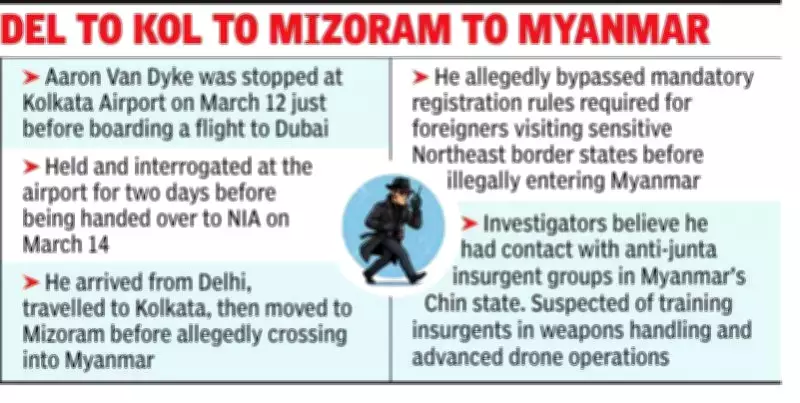
Fresh details emerging from the investigation into the arrest of US national Aaron Van Dyke have revealed a dramatic sequence of events at Kolkata airport. According to official sources, Van Dyke was detained for nearly two full days before being formally handed over to the National Investigation Agency (NIA). Authorities were meticulously piecing together his suspected cross-border activities and alleged connections with insurgent groups during this critical period.
The Airport Interception and Extended Detention
Based on inputs shared by Bidhannagar Police and airport immigration officials with the NIA, Van Dyke was intercepted on March 12 in what officials described as a "last-minute intervention" based on specific intelligence alerts. The interception occurred moments before he was scheduled to board FlyDubai flight FZ 462 to Dubai.
"His luggage had already been checked in and loaded onto the aircraft. He had cleared immigration and was about to depart when he was stopped," revealed a senior official involved in the operation. From Dubai, Van Dyke had planned to connect to flight FZ 1839 bound for Warsaw, Poland.

Instead of continuing his journey, Van Dyke was escorted to an immigration holding facility within Kolkata airport, where he remained under sustained interrogation for two full days. During this intensive questioning period, officials examined his complete travel trail, contacts, and suspected movements across various conflict zones.
"After preliminary interrogation, the NIA took him into custody on March 14 for further investigation," the official added, confirming the timeline of events.
Suspected Border Violations and Myanmar Connections
Investigators have since reconstructed significant portions of Van Dyke's movements within India. After arriving from Delhi alongside a group of Ukrainian nationals, Van Dyke traveled to Kolkata and then proceeded to Mizoram. From there, he allegedly crossed the international border into Myanmar without completing mandatory formalities required for foreign nationals visiting sensitive northeastern states.
Under existing regulations, foreigners entering border states such as Mizoram, Nagaland, and Manipur must register with the local Foreigners Registration Office within 24 hours of arrival. Officials confirmed that Van Dyke deliberately bypassed these critical security requirements.
Sources indicated that during his time in Myanmar's Chin state, Van Dyke is suspected to have provided training to anti-junta insurgent groups in weapon handling and advanced drone operations. Investigators believe the nature of this training, particularly involving military-grade drone capabilities, poses significant security concerns for India's northeastern region.
Broader Security Implications and Ukrainian Connections
Security agencies are now conducting comprehensive assessments of the broader implications of these activities. Intelligence inputs suggest that several insurgent outfits operating along the India-Myanmar border maintain established links with extremist groups in India's Northeast. Officials have warned that the introduction of advanced drone technology into this volatile ecosystem could dramatically escalate the operational capabilities of such militant groups.
In a related development on March 13, three Ukrainian war veterans—Petro Hurba, Taras Slyviak, and Ivan Sukmanovskyi—were detained by Bureau of Immigration officials at Lucknow airport and subsequently handed over to the NIA. These individuals are believed to have provided key leads about Van Dyke's activities and connections.
Additionally, three more Ukrainians—Stefankiv Marian, Honcharuk Maksim, and Kaminskyi Viktor—were held in Delhi as part of the expanding investigation. The NIA has stated that the trio held in Lucknow entered India from the UAE on tourist visas last December before traveling to Mizoram without obtaining the mandatory restricted-area permits.
During their stay in India, they are suspected to have crossed into Myanmar and established contacts with armed groups considered hostile to Indian security interests. The investigation continues to uncover the full extent of these international connections and their implications for regional security.






