

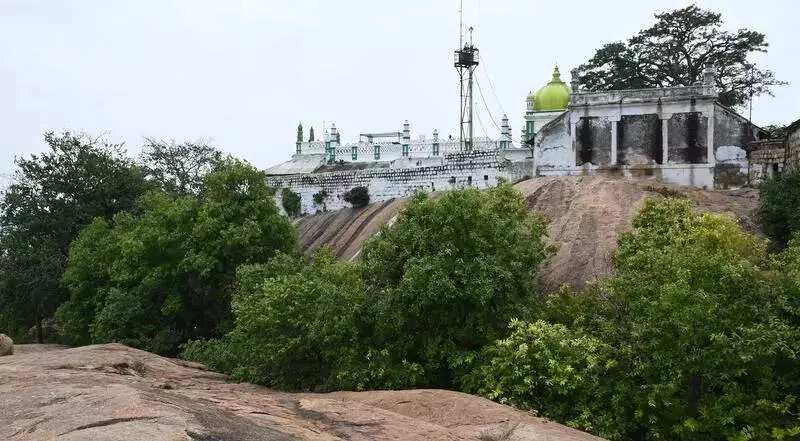
A legal dispute over a stone pillar atop the historic Thiruparankundram hill in Madurai district has intensified, with the Tamil Nadu Wakf Board asserting that the site belongs to the Sikandar Badusha Dargah. The Board made this argument before the Madras High Court on Tuesday, countering a previous judicial order that permitted the lighting of a lamp on the pillar.
Core of the Legal Argument
The counsel representing the Wakf Board presented a crucial historical document to a division bench comprising Justice G Jayachandran and Justice K K Ramakrishnan. The counsel cited a judicial order from a 1920 civil suit, which contained findings that the flight of stairs leading from Nellithope to the hill summit belonged to the dargah. Furthermore, the order stated that the summit of the hill and its adjuncts were the property of the Mohammedans, an area that includes the location of the contested stone pillar and a mandapam.
The Board's lawyer emphasized that access to the stone pillar is only possible through the dargah's property. He argued that the matter of right of passage is a civil issue that must be decided by a civil court. As a potential resolution, he suggested that the entire issue could be settled through a court-monitored mediation process.

Challenging the "Deepathoon" Nomenclature
In a strong rebuttal, the senior counsel representing the Madurai District Collector and the City Police Commissioner challenged the very basis of the petition. He pointed out that earlier High Court orders from 1996 and 2014 made no mention of any "Deepathoon" (stone lamp pillar). He labeled the term as a "figment of imagination" conjured by the petitioner and later adopted by the single judge who issued the initial order.
"Deepathoon is the figment of a single judge's imagination or the petitioner's imagination to which the single judge latched on," the senior counsel argued. He questioned the evidence proving the pillar was ever used as a Deepathoon, noting that even the petitioner's original representation to temple authorities did not use this term. He contended that the petitioners have no fundamental or legal right to seek to light the Deepam at a new, disputed location.
Concerns Over Public Order and Judicial Overreach
The counsel for the administration raised serious concerns about the single judge's order. He argued that the directive to light the lamp using the dargah's steps was contrary to the judge's oath and questioned how a writ court could go to such lengths, potentially disturbing public order. He stressed that both Hindu and Muslim communities have lived in peace in the area, and this harmony was being disrupted by the court's directive.
The judge's order, according to the counsel, failed to consider whether the pillar could be accessed via the dargah's stairs without infringing upon the rights of the dargah. The hearing has adjourned, with the court expected to deliberate on these complex arguments involving property rights, religious practice, and historical evidence.






