

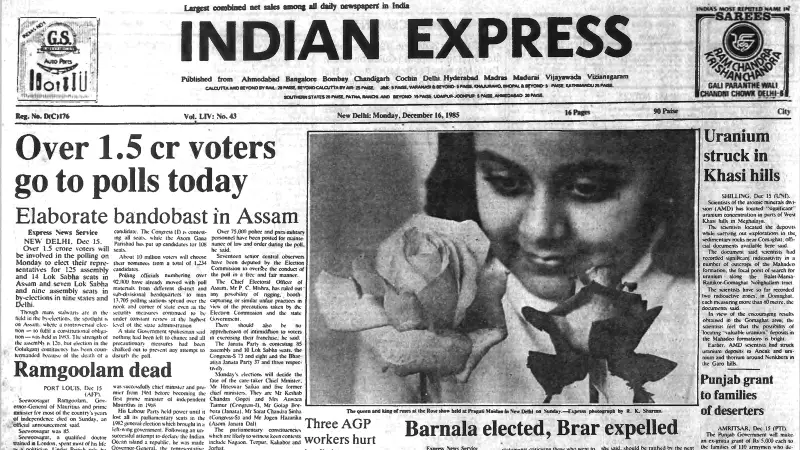
December 16, 1985, was a day of significant political and scientific developments across India and the world. The front page of The Indian Express from that date captured a nation in motion, with millions voting in crucial elections, a major political party undergoing internal transformation, a landmark uranium discovery, and a key international nuclear agreement.
Nation Heads to the Polls in Assam and By-Elections
The primary focus of the day was the democratic exercise unfolding across several states. Over 1.5 crore (15 million) voters were set to cast their ballots to elect representatives for 125 assembly and 14 Lok Sabha seats in Assam. Simultaneously, by-elections were being held for seven Lok Sabha and nine assembly seats across nine states and Delhi.
While several political stalwarts were in the fray for the by-elections, the national spotlight was firmly on Assam. This election held particular significance as it followed a highly controversial state election conducted in 1983, which was mandated to fulfill a constitutional obligation. The Congress (I) contested all seats in Assam, while the Asom Gana Parishad (AGP) fielded candidates for 108 seats. To facilitate this massive electoral process, over 92,000 polling officials had already been deployed, moving with election materials from various district and sub-divisional headquarters.

Akali Dal Elects Barnala, Expels Balbir Singh Brar
In a major political development within the Shiromani Akali Dal, the party's general house took decisive actions. The members unanimously elected the then Chief Minister, Surjit Singh Barnala, as the party president for a two-year term. In a contrasting move, the house expelled Balbir Singh Brar from the primary membership of the party.
The general house also granted Barnala sweeping authority to reorganize the party structure. He was authorized to nominate all office-bearers of the Akali Dal and to dissolve all its subsidiary bodies. This included the parliamentary board, the youth wing, and the Sikh Intellectual Council. These bodies were to be reconstituted under Barnala's leadership. This consolidation of power came after Barnala was appointed the acting president of the party by district jathedars following the assassination of Harchand Singh Longowal on August 31, 1985.
Significant Uranium Deposits Located in Meghalaya
In a breakthrough for India's atomic energy program, scientists from the Atomic Minerals Division (AMD) discovered "significant" concentrations of uranium in parts of the West Khasi Hills district in Meghalaya. Official documents from Shillong revealed that the deposits were located during explorations in sedimentary rocks near the area of Gomaghat (referred to as Comaghat in the report).
The documents stated that scientists had recorded substantial radioactivity in several outcrops of the Mahadeo formation, which was the focal point of the uranium search. Two distinct radioactive zones, each measuring more than 80 metres, were identified in the Gomaghat area, marking a promising find for the nation's nuclear fuel resources.
International Deal: France and China Agree on Nuclear Plant
On the global stage, France and China reached an agreement in principle for the construction of a nuclear power station at Daya Bay in China's Guangdong province. The accord was finalized during a visit to France by the Chinese Vice-Premier, Li Peng. The French Industry Ministry announced that the agreement covered the plant's total cost and the broad outlines of a financial package. The overall project was estimated to cost around 20 billion French francs (approximately $2.6 billion at the time), signifying a major step in international nuclear cooperation.
The events of December 16, 1985, thus painted a picture of a day where democracy, political realignment, scientific progress, and international diplomacy all played out on the front pages, leaving a lasting imprint on India's contemporary history.






