

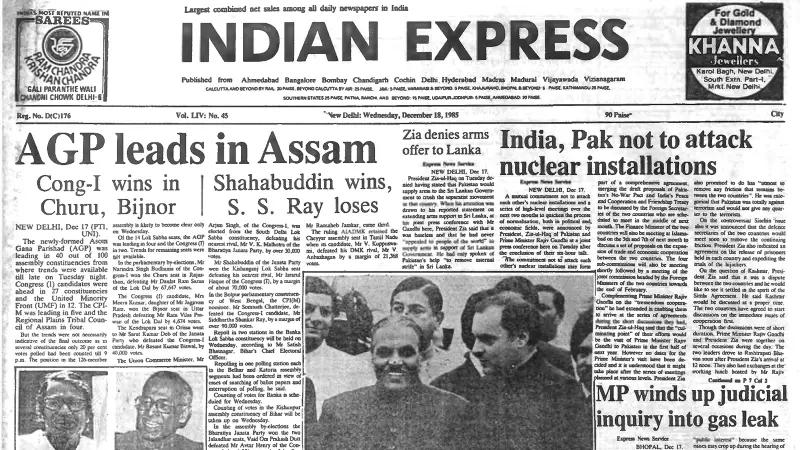
December 18, 1985, was a day of significant developments across the political, sports, and diplomatic spheres in India. Front-page news captured a potential political shift in Assam, a historic achievement in cricket, a crucial bilateral agreement, and a controversial decision regarding a national tragedy.
Assam Assembly Election Trends: AGP Takes Early Lead
In the emerging trends for the Assam legislative assembly elections, the newly formed Asom Gana Parishad (AGP) was making a strong showing. According to available data from 100 constituencies, the AGP was leading in 40 seats. The Congress (I) was ahead in 27 constituencies, while the United Minority Front (UMF) led in 12. Other parties like the CPI(M) and the Regional Plains Tribal Council of Assam were leading in five and four seats, respectively.
However, these early trends came with a major caveat. Officials cautioned that the picture was not definitive, as in several constituencies, only 20 per cent of the votes had been counted until 9 pm on December 18. The final outcome remained uncertain, but the trends pointed to a robust performance by the regional party.

Sunil Gavaskar Creates Test Cricket History
On the cricket field, Indian legend Sunil Gavaskar etched his name in the record books during the first Test against Australia in Adelaide. Gavaskar scored an unbeaten 166 runs, a magnificent innings that propelled him past a monumental milestone. He became the first cricketer in history to score more than 9,000 runs in Test cricket.
This landmark century was also his 31st Test hundred. Despite India posting a formidable first-innings total of 520—their highest against Australia at the time—the match was heavily affected by rain and ultimately ended in a draw.
Rajiv Gandhi and Zia-ul-Haq Forge Nuclear Agreement
In New Delhi, a crucial diplomatic announcement followed six hours of talks between Prime Minister Rajiv Gandhi and Pakistan's President Zia-ul-Haq. At a joint press conference, the two leaders announced a mutual commitment that their countries would not attack each other's nuclear installations.
Furthermore, they agreed to schedule a series of high-level meetings over the next two months. The goal of these meetings was to accelerate the process of normalization between India and Pakistan, covering both political and economic fields.
Bhopal Gas Tragedy Inquiry Abruptly Closed
In a controversial move concerning the Bhopal gas leak disaster, the Madhya Pradesh government decided to wind up the judicial commission investigating the tragedy. Chief Minister Motilal Vora made a dramatic announcement in the state assembly, declaring that the government would not extend the term of the commission headed by Justice N K Singh.
The commission had been inquiring into the catastrophic industrial accident for the past year. The government's decision prompted immediate outrage from the opposition, whose members staged a walkout from the assembly in protest.
This day in 1985, therefore, stands as a snapshot of a nation in flux—witnessing political change, sporting glory, diplomatic maneuvering, and the ongoing struggle for justice in the aftermath of an industrial disaster.






