

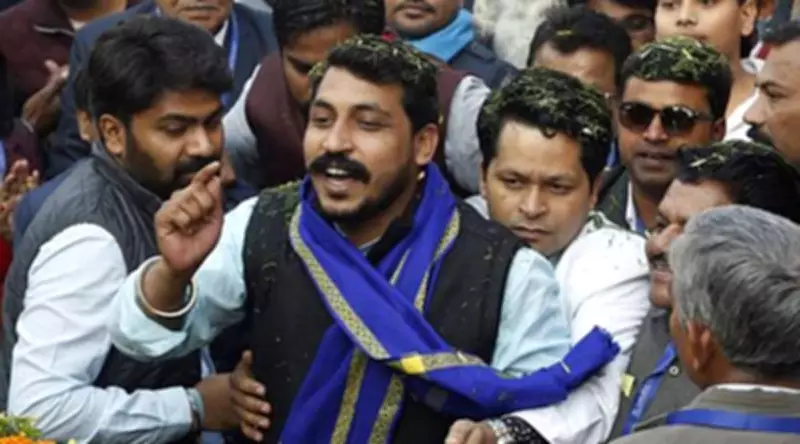
The Aazad Phenomenon: Nagina MP's Rallies Captivate Uttar Pradesh as Political Rivals Take Note
In the lead-up to the crucial Uttar Pradesh Assembly elections scheduled for early 2027, the political landscape is witnessing a significant shift. Chandra Shekhar Aazad, the charismatic chief of the Azad Samaj Party (Kanshi Ram) and Member of Parliament from Nagina, has been commanding substantial attention through a series of high-energy rallies across the state. Dubbed the Samvidhan Adhikar Bachao (Save Constitutional Rights) rallies, these events have drawn impressive crowds, prompting both the ruling Bharatiya Janata Party (BJP) and opposition factions to closely monitor his growing influence.
Mobilizing the Masses: A Statewide Campaign for Social Justice
Chandra Shekhar Aazad's mobilization drive has seen him address large public gatherings in key districts including Kannauj, Agra, and Sant Kabir Nagar. At these rallies, the Dalit leader has passionately articulated themes of social justice, Constitutional rights, and urgent reforms in higher education. His speeches resonate deeply with younger voters and sections of the Dalit community who are actively seeking an alternative political voice beyond traditional parties.
In Kannauj, Aazad made a significant announcement regarding a protest scheduled for February 11 in Delhi. This demonstration is squarely focused on supporting the University Grants Commission (UGC) regulations, which have become a contentious issue in recent months. Launching a sharp critique, Aazad accused mainstream political parties of abandoning Dalit interests by remaining silent on the UGC matter. "On one side, large-scale protests are being organized to defend the UGC, while on the other, leaders who claim to be your well-wishers have gone completely silent," he declared emphatically.

The MP asserted that his party stands alone in its unequivocal support for the UGC norms. "The Azad Samaj Party is the only political entity, the Bhim Army the sole organization, and Chandra Shekhar Aazad the singular leader who is boldly advocating for the full implementation of the UGC regulations," he proclaimed to cheering supporters.
The UGC Regulations: A Divisive Policy Fueling Political Fire
The new UGC regulations, designed to apply uniformly across all higher education institutions, establish a structured framework for addressing discrimination-related complaints. Key provisions mandate every institution to establish an Equal Opportunity Centre, an Equity Committee, and Equity Squads to operationalize these objectives.
However, these regulations have sparked intense controversy. A segment of students and the BJP have raised objections, alleging that the rules could potentially lead to "harassment" of students from general categories and might foster divisions along caste lines. Critics point to the absence of penalties for false discrimination complaints and the potential for institutional action against non-compliance as particularly problematic aspects.
The political dimensions of this issue intensified when the Supreme Court stayed the UGC guidelines on January 29, describing them as "arbitrary" and warning they could "divide society." This judicial intervention reportedly dealt a blow to the BJP, with accounts emerging of 11 party office-bearers resigning in protest against the regulations. According to BJP insiders, the party is considering launching a national outreach program next month to counter the "negativity" surrounding these provisions.
Political Reactions: Dismissals and Strategic Calculations
The sustained mobilization by Aazad has not gone unnoticed by established political players. Leaders from his party claim that his sharply critical speeches targeting both the BJP and opposition parties are finding particular resonance among youth and Dalit voters disillusioned with traditional politics.

Nevertheless, both the BJP and Mayawati-led Bahujan Samaj Party (BSP) have sought to downplay Aazad's impact. BJP spokesperson Rakesh Tripathi dismissed the large crowds as merely a "curious crowd" drawn by novelty rather than political conviction. "When new figures emerge on the political scene, they naturally attract attention, much like Arvind Kejriwal did initially. However, they often lack long-term viability due to the absence of a strong ideological foundation and robust grassroots organization," Tripathi argued.
BSP state president Vishwanath Pal echoed this skepticism, questioning Aazad's political clout by referencing the Milkipur Assembly by-election where the BSP abstained from contesting. "If he truly is such an influential Dalit youth leader, why did his party fail to secure a significant vote share in that election?" Pal challenged. He further suggested that Aazad should have accepted the Supreme Court's ruling on the UGC guidelines instead of "provoking the youth" over the issue, maintaining that Dalit votes remain firmly with the BSP.
Electoral Implications: Reshaping the Dalit Vote Landscape
The INDIA opposition bloc is also closely observing Aazad's rallies, given their strategic focus on consolidating Dalit support ahead of the Assembly elections. A senior leader acknowledged that the BSP's limited campaign presence during the 2024 Lok Sabha elections had inadvertently benefited the Congress by shifting Dalit votes. "For the 2027 Assembly elections, both the Congress and the Samajwadi Party were anticipating a similar trend," the leader revealed, noting that Aazad's aggressive outreach to the Dalit community has complicated these calculations.
With the Jatav Dalits traditionally forming the core voter base of the BSP—a party that has experienced declining electoral fortunes over the past decade—Aazad's emergence introduces a new dynamic. Political analysts suggest that if his current momentum persists, he could potentially emerge as a significant force capable of influencing outcomes during the upcoming polls. As Uttar Pradesh's political theater prepares for another intense electoral battle, all eyes remain fixed on the rising trajectory of Chandra Shekhar Aazad and the evolving allegiances of Dalit voters.





