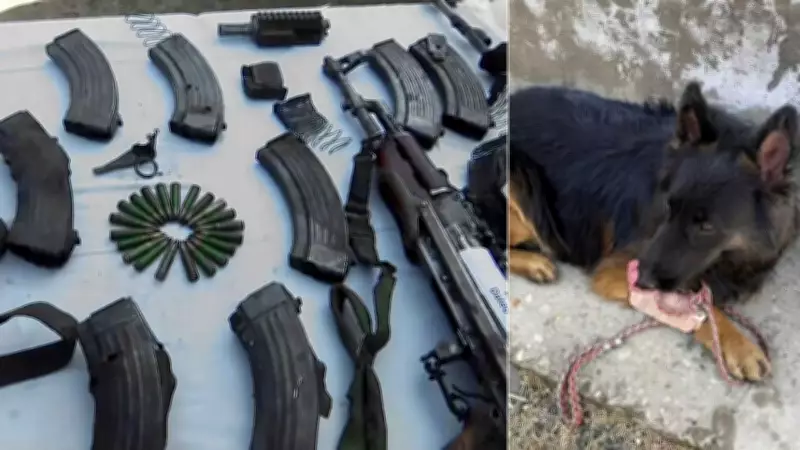
Army Canine Tyson's Courageous Charge Helps Neutralize Three JeM Terrorists in Kishtwar Operation
Not all heroes in the Indian Army wear uniforms, as demonstrated by Tyson, a four-legged soldier whose extraordinary bravery played a pivotal role in a recent counter-terrorism operation in Jammu and Kashmir. This courageous canine charged first into a terrorist hideout in the Chhatroo belt of Kishtwar district, enabling security forces to eliminate three hardcore Jaish-e-Mohammed terrorists despite sustaining a bullet injury to his leg during the intense confrontation.
Local Dog Transformed into Army's Silent Warrior
Tyson represents a remarkable example of how local resources can be leveraged for national security. According to sources in Delhi, the Indian Army adopted and trained this local dog specifically for counter-terror operations, transforming him into what officials describe as a "silent warrior" capable of operating in the most challenging environments.
During the operation, Tyson crawled into a hideout carved into the rugged terrain of Chhatroo, prompting the terrorists to open fire. Despite being shot, the determined canine continued his mission, becoming the first to reach near the 'dhok' (mountain hut) and enabling the security team to access the hideout and neutralize the terrorists. Following his heroic actions, the injured dog was airlifted for urgent medical treatment and is currently recuperating in Udhampur, where officials confirm "he is doing fine."

Operation Trashi-1: A Year-and-a-Half Long Counter-Terror Campaign
This operation, codenamed 'Operation Trashi-1,' represented a massive multi-agency counter-terrorism effort that reflected months of meticulous planning and an integrated approach involving the Army's Counter Insurgency Force (Delta), local police, and the Central Reserve Police Force (CRPF).
During a joint press conference in Jammu, Inspector General of Police Jammu B S Tuti revealed that the operation culminated a year-and-a-half-long campaign against a terror group called the 'Israel Group,' which comprised seven hardcore terrorists who had infiltrated Indian territory in 2024. Security forces had engaged this group 17 times over the extended period, with three terrorists eliminated in April 2025 before the recent operation completed the mission.
"Yesterday was the culmination of this year-and-a-half-long operation," Tuti stated, referring specifically to the killing of JeM commander Saifullah. "Yesterday's operation is indicative that we have neutralised their leadership in Kishtwar. However, their foot soldiers remain active in other areas." The IGP estimated that approximately 20 foreign terrorists continue to operate in the Jammu region, though he didn't specify exact numbers.
Seamless Coordination and Perseverance in Challenging Conditions
Major General APS Bal, General Officer Commanding of the Counter Insurgency Force (Delta), described Operation Trashi-1 as "a perfect example of perseverance, clarity of thought and seamless coordination at all levels." He emphasized that all available resources were deployed in a joint and integrated manner, "from a dog to a drone," highlighting the comprehensive nature of the operation.
The operation officially commenced on January 14 in Kishtwar, with first contact established on January 18 when security forces busted the terrorists' hideout. Subsequent encounters occurred on January 22, January 25, January 31, February 4, and February 8, demonstrating the prolonged and persistent nature of the campaign.
Major General Bal detailed the extreme challenges faced by security personnel, including harsh terrain, adverse weather conditions with snowfall and rain, and dangerous landslides. To prevent fatigue, forces were regularly rotated, with some teams inserted by helicopter and others undertaking grueling 6-8 hour treks to reach operational areas.
"Every day we sat at the drawing board, reoriented and realigned ourselves, redeployed and started working again," the senior officer explained, underscoring the adaptive nature of the operation.

Strategic Breakthroughs and Tactical Success
The first significant breakthrough occurred on February 4 with the elimination of commander's aide Adil. On February 21, critical intelligence shared by the Senior Superintendent of Police Kishtwar was passed to the brigadier of 9 Sector and corroborated through multiple agencies, leading to the launch of a joint operation in the rugged mountains.
Security forces quickly mobilized reinforcements, including special forces units, while employing real-time surveillance drones and night vision equipment to track and contain terrorist movements effectively. This technological integration with ground operations proved crucial to the mission's success.
Remarkably, the operation achieved its objectives without any casualties or harm to security personnel, with the exception of Tyson's injury. During subsequent searches of the area, security forces recovered significant war-like stores, including three AK-47 rifles, along with the bodies of the slain terrorists, providing tangible evidence of the operation's success.
Major General Bal emphasized the significance of this achievement, noting that the safe conclusion of such a complex operation without troop casualties represents a substantial victory for counter-terrorism efforts in the region.