

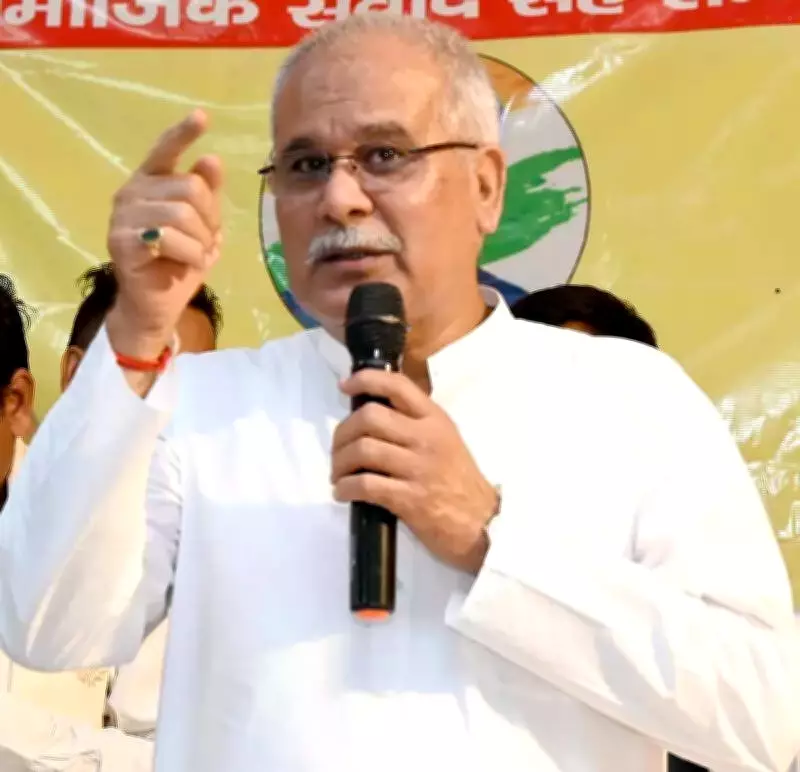
Former Chhattisgarh Chief Minister Bhupesh Baghel Challenges BJP's Maoist Eradication Claims
In a significant political development, former Chhattisgarh Chief Minister Bhupesh Baghel has openly questioned the Bharatiya Janata Party (BJP) government's assertions regarding the decline in Maoist violence. This challenge comes in the wake of an incident where Bijapur police requested Congress MLA Vikram Mandavi to postpone his scheduled tour of interior villages, citing substantial security threats.
Security Concerns Halt MLA's Constituency Visit
The controversy erupted when the Bijapur police formally wrote to MLA Vikram Mandavi, urging him to defer his proposed visit to villages in the Bhopalpattanam area. The police cited the region's status as a Maoist-affected zone with limited infrastructure, including kutcha road access, and ongoing potential for insurgent activity. They expressed concerns that Mandavi could be intercepted or prevented from proceeding into these sensitive areas, thereby posing a risk to his safety.
However, Mandavi remained defiant, stating to The Times of India that ensuring security is the government's fundamental responsibility. "If the government cannot provide security, that is their issue. I will definitely go," he asserted. The MLA emphasized his commitment to his constituents, noting that he had already embarked on his journey to remote villages like Pilur, Edapalli, Sandra, Chhotekerkel, and Gudum. "I am an elected representative from this region, and no one can stop me from visiting my constituency and its people," he declared.

Baghel's Scrutiny of Government Claims
Bhupesh Baghel seized upon this incident to critique the BJP administration's narrative on Maoist insurgency. He pointedly referenced Union Home Minister Amit Shah's statement that Maoists would be "eradicated from the roots by March." Baghel posed a series of probing questions: "The BJP government says MLAs cannot go on tours. So what is the truth? If Maoist activities are still continuing, what exactly is ending?" He contrasted this with his previous tenure, claiming, "Our government was better, at least MLAs could travel without being stopped."
Mandavi further alleged that the real issue extends beyond security. He suggested that the government might be attempting to conceal the ground realities within these villages. "The actual problem is that they don't want the reality inside the villages to come out in the open," he claimed. In a show of resistance, Mandavi warned that if obstructed, he would stage a sit-in protest on the spot.
Broader Implications and Tribal Rights Concerns
The situation also highlights deeper issues related to tribal rights and governance in Chhattisgarh's conflict zones. Mandavi raised allegations of constitutional violations, specifically regarding mining and development projects in tribal-majority regions. He stated, "Gram Sabha approval and consent are compulsory for such projects. But in this case, there was no consultation with the Gram Sabha of Kuchnoor, no public hearing, and the panchayats were not even informed. This is a clear violation of the constitutional rights of tribals."
This incident underscores the ongoing tensions between political accessibility, security protocols, and transparency in regions affected by left-wing extremism. It brings into sharp focus the disconnect between governmental assurances of improved security and the persistent operational challenges on the ground.
The developments in Bijapur reflect a critical moment in Chhattisgarh's political landscape, where claims of progress in counter-insurgency efforts are being tested against the practical realities faced by elected representatives and local communities. The outcome of Mandavi's tour and the government's response may have significant ramifications for public trust and policy effectiveness in addressing Maoist violence.






