Bengaluru Landfill Crisis Resolved with Major Financial Package
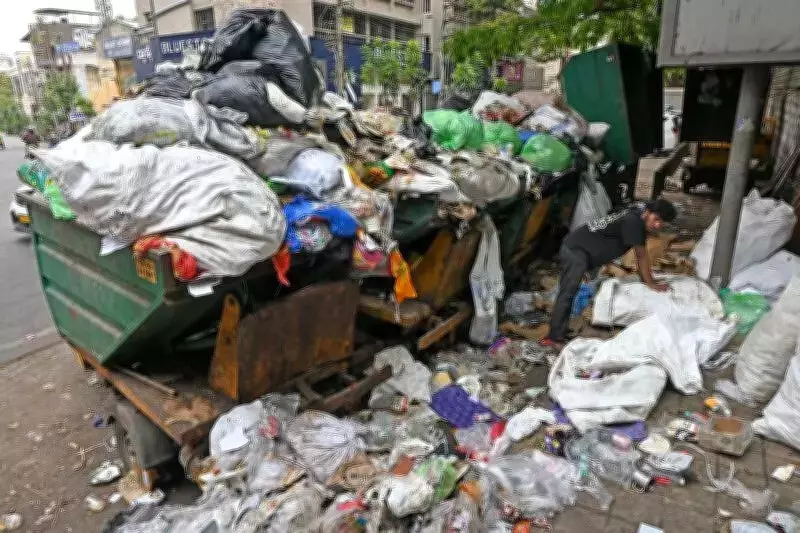
The two-day stalemate between Bengaluru's civic authorities and residents of landfill villages over infrastructure development funds concluded late Wednesday night with the state government announcing a substantial Rs 550 crore package. Officials expressed hope that this decisive move would restore normalcy in garbage-disposal operations, which had been completely halted at the Bellahalli dumpsite for the past two days following intense protests from local residents.
Widespread Impact of the Landfill Blockade
The blockade at the Bellahalli landfill created significant ripple effects across Bengaluru's waste management system. Nearly 600 families reside in Bellahalli and Mittaganahalli, where the 30-acre landfill receives approximately 1,500 tonnes of waste from Bengaluru daily. The protest's impact was felt in numerous neighborhoods including Kalasipalya, JP Nagar, Konanakunte, RR Nagar, BTM Layout, Sahakarnagar, Rajajinagar, Basaveshwaranagar, and Kammanahalli, where residents reported that waste collection had ceased entirely.
Across these affected areas, buckets and garbage bags accumulated outside homes and on street corners, raising serious concerns about the emergence of new blackspots throughout the city. The situation became so critical that authorities, including Deputy Chief Minister DK Shivakumar, engaged in tough negotiations with protesting residents who initially refused to compromise on their demands.

Residents' Longstanding Grievances and Health Concerns
"We are living next to 1,500 tonnes of garbage every single day. The smell has become unbearable, our groundwater is severely polluted, and we don't even have access to regular drinking water supply," explained Gangesh Manjunath, a resident of Mittaganahalli, highlighting the daily challenges faced by community members.
Lakshmamma Gowda, another villager, added, "We depend entirely on water tankers for our daily needs. If the government can dump the entire city's waste here, why can't it provide us with basic facilities? For years, we have consistently asked for proper roads, clean drinking water, and adequate health facilities. They only remember our existence when they need to send garbage trucks. This protest represented our absolute last resort."
Comprehensive Financial Allocation Announced
To prevent the garbage crisis from escalating further, Bengaluru Solid Waste Management Limited (BSWML) announced the release of substantial development funds on Wednesday night. Kari Gowda, CEO of BSWML, confirmed the detailed allocation: "Village development funds have been officially allocated as follows, with orders already issued: Rs 90 crore each for Mahadevapura, Byatarayanapura, and Yeshwanthpur; Rs 50 crore for Anekal; Rs 20 crore for Bengaluru South; and Rs 10 crore for Doddaballapur. Additionally, in phase two of this initiative, Byatarayanapura and Mahadevapura will receive an additional Rs 100 crore each."
Gowda further elaborated on operational changes, stating, "We have also made the strategic decision to minimize the number of vehicles traveling to the landfill in the coming months and to confine waste transportation within a more strictly regulated framework."
Residents Detail Environmental and Health Impacts
Chennakrishna V, former panchayat member of Mittaganahalli and current resident, described the severe environmental consequences: "There is an enormous quantity of organic and mixed waste being dumped here continuously. This has resulted in significant leachate generation that is contaminating our borewells. We no longer have access to safe drinking water. Our homes are constantly filled with mosquitoes, making it nearly impossible to keep doors and windows open. When the deputy chief minister visited, he acknowledged awareness of the issue but admitted they didn't know where else to dump the waste. How are we supposed to have solutions if the government itself lacks alternatives?"

Ramanji RT, a stonecrusher-supervisor and Mittaganahalli resident, added, "Leachate stagnates near both our workplaces and residential areas. Every single day, we must use motors to clean our sumps. Even with these efforts, the stench makes breathing difficult. Heavy mosquito infestations plague our community, and clean drinking water remains unavailable. Many residents experience skin irritation and persistent itching. Proper roads are nonexistent, and despite our repeated complaints, nothing substantial has been done until now."
Syed Masthan, a private employee from Mittaganahalli, concluded, "A horrible smell permeates the entire area, and even local lakes have become filled with leachate. Seven residential layouts exist here, with many residents being farmers whose lands have been badly affected. Our agricultural fields suffer from severe infestation and pollution. We depend entirely on water tankers, spending approximately Rs 700 weekly, but this arrangement is completely unsustainable. Mixed waste, including animal waste, represents another serious problem that requires immediate attention."