

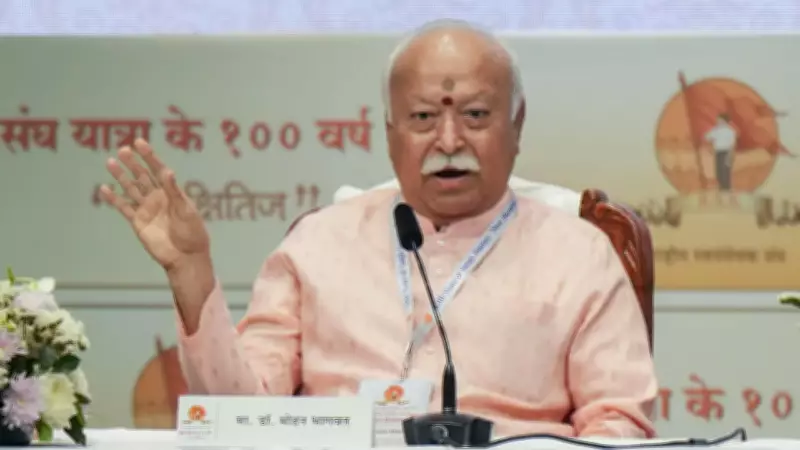
RSS Chief Mohan Bhagwat Advocates Bharat Ratna for Savarkar, Congress Opposes
Rashtriya Swayamsevak Sangh (RSS) chief Mohan Bhagwat on Sunday asserted that the prestige of India's highest civilian honor, the Bharat Ratna, would be significantly enhanced if it were conferred upon Hindutva ideologue Vinayak Damodar Savarkar. This statement, made during a public interaction in Mumbai to mark the RSS centenary, has reignited a long-standing and politically charged debate over Savarkar's legacy.
Bhagwat's Remarks at RSS Centenary Event
Speaking at the event, which was attended by several prominent personalities from the film and cultural world, Bhagwat emphasized that the longstanding demand to honor Savarkar with the Bharat Ratna deserves serious consideration. "Bharat Ratna's prestige will increase if the award is given to Savarkar," he declared, reiterating a position that has been consistently echoed by sections of the Sangh Parivar and the Bharatiya Janata Party (BJP) over the years.
Bhagwat made these comments while responding to questions on a range of issues, including the Uniform Civil Code, nationalism, and the role of the RSS in public life. His remarks have brought the contentious issue back into the political spotlight, highlighting the deep ideological divides surrounding Savarkar's contributions and historical role.

Congress Launches Sharp Attack on the Proposal
The Congress party reacted immediately and strongly to Bhagwat's statement. Party MP Imran Masood, speaking to reporters in Varanasi, questioned the basis on which Savarkar should be awarded the Bharat Ratna and accused him of contributing to the idea of India's partition. "On what grounds should he be awarded the Bharat Ratna? For what merit? For causing the partition of India and Pakistan?" Masood demanded.
He further elaborated, "It was Savarkar who first propagated the idea of two nations within the country and laid the ideological foundation for the division between India and Pakistan." This sharp criticism underscores the Congress's consistent opposition to any move to honor Savarkar with the Bharat Ratna, citing his controversial views and alleged links to the conspiracy in Mahatma Gandhi's assassination.
Historical Context and Political Backdrop
This latest exchange occurs against the backdrop of a decades-long and politically charged debate over Savarkar's legacy. While the BJP and its ideological affiliates project him as a freedom fighter and a key ideologue of Hindutva who suffered harsh incarceration under British rule, the Congress has vehemently opposed honoring him.
The issue first gained major political traction in 2019 when the BJP's Maharashtra unit included a promise in its election manifesto to seek the Bharat Ratna for Savarkar. The Congress had then hit out sharply, with senior leader Manish Tewari stating that conferring the award on Savarkar, especially around Mahatma Gandhi's 150th birth anniversary, would be deeply inappropriate.
At that time, the BJP defended the demand, arguing that Savarkar was a freedom fighter who spent years in harsh imprisonment in the Andaman Cellular Jail and that many national leaders, including B.R. Ambedkar and Sardar Patel, received the Bharat Ratna long after Independence.
Recent Developments and Political Reactions
The demand resurfaced in 2024 as well, when Shiv Sena (UBT) chief Uddhav Thackeray questioned why the BJP-led central government had not yet honored Savarkar despite repeated assurances and letters from BJP leaders themselves. Thackeray asserted that the ruling party had no right to lecture others on Savarkar if it failed to act on its own promises.
This ongoing controversy reflects the broader ideological battles in Indian politics, where historical figures like Savarkar are often used as symbols to rally support and critique opponents. The debate over the Bharat Ratna for Savarkar is not merely about an award but touches upon deeper questions of national identity, historical interpretation, and political legacy.
As the RSS continues to push for this recognition and the Congress remains steadfast in its opposition, the issue is likely to remain a flashpoint in political discourse, especially as election cycles approach and parties seek to mobilize their respective voter bases around symbolic issues.






