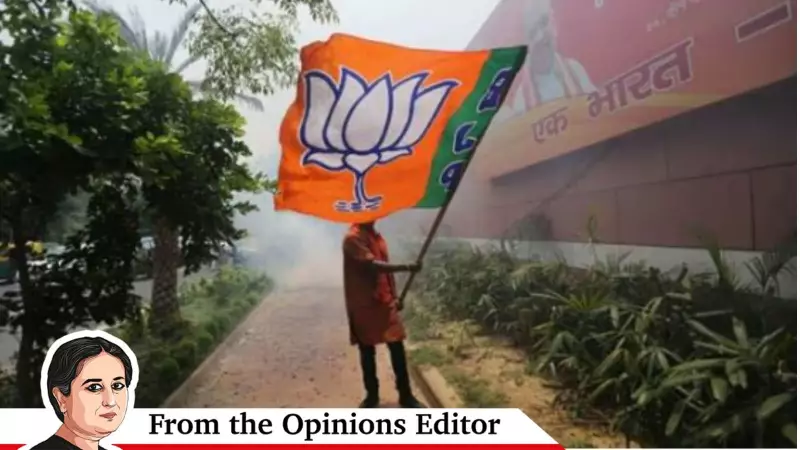
As the new year of 2026 unfolds, a profound sense of bleakness grips India's political landscape. The transition from the old year has been marked not by hope, but by a disturbing continuity of hate and governmental abdication, even as the opposition struggles to articulate a coherent and resonant response.
A Litany of Failures: Vigilantism and Accountability Gaps
The closing month of 2025 presented a disheartening series of events. In December, a young student from Tripura was fatally attacked in Dehradun in a clear hate crime, yet senior BJP figures refused to name it as such. Across several states, attacks on churches and congregations before Christmas, often by mobs alleging conversions, were met with a similar, deafening official silence.
Chhattisgarh has become a focal point for anti-Christian violence. The climate of impunity was starkly illustrated when six Bajrang Dal members, arrested for vandalizing Christmas decorations at a Raipur mall, were greeted with garlands and a celebratory procession upon receiving bail. In a separate incident in Bareilly, vigilantes disrupted a young woman's birthday party at a cafe simply because two of her guests were Muslim.

Governance failures extend beyond communal violence. In Indore, repeatedly awarded as India's cleanest city, contaminated drinking water led to deaths. A senior BJP minister dismissively brushed aside questions about accountability, offering only a weak apology later. Meanwhile, in Maharashtra, local body elections descended into political chaos with unlikely alliances, highlighting a system in disarray. Notably, 68 candidates from the ruling BJP-Shinde Sena alliance were elected unopposed across municipal corporations.
In Parliament, the Modi government rushed through a bill that significantly weakens MGNREGA, centralizing control over funds and works and diluting its decentralized assurance to the poorest. The justice system also faces scrutiny, exemplified by the case of scholar Umar Khalid, who has spent over five years in jail without charges being framed or a trial beginning. The Chief Justice of India's recent emphasis on 'empathy' only underscored its absence in such prolonged incarcerations.
The Entangled Themes Undermining Democracy
These are not isolated incidents. They form a pattern resting on interconnected themes: the empowerment of vigilantes, governance that resists accountability, the use of law to bend the rule of law, and the undermining of democracy using its own toolkit. This creates a perverse ecosystem where constitutional safeguards are systematically eroded.
Yet, the Congress-led opposition, despite its strong rhetoric, appears bewildered and helpless. It is puzzled by the BJP's continued electoral success and unsure how to counter it. Its argument about the Constitution and democracy being in danger primarily resonates only with Dalits and Muslims—communities most reliant on these protections—but fails to ignite a broader movement.
The BJP's Narrative vs. The Opposition's Vacuum
In this turmoil, the BJP has adeptly positioned itself as the authentic carrier of the "voice of the people," promising to liberate it from the debris of the old order. It projects emotive, unifying visions—be it "Hindu Rashtra," "Viksit Bharat," or a "Decolonised India"—that create powerful identity-based appeal and comfort zones. However, these unifying wholes are fundamentally predicated on the continued exclusion of the Muslim minority and serve to deflect demands for governmental accountability.
The opposition, however, seems unable to even fully diagnose the deeper crisis of representation and legitimacy that fuels the BJP's rise, let alone craft a compelling language to challenge it. To succeed, it must find the imagination to repurpose the BJP's narratives—for instance, by reframing Hinduism around its inherent pluralism instead of ceding that ground. Alternatively, it must frame a new, inclusive "imagined community" that can invite all Indians in.

While strategist Prashant Kishor's simple pitch in Bihar—"vote for your child's future"—attempted to bridge caste and community cleavages, it was not enough. For now, as 2026 begins, an opposition stuck with an outdated vocabulary remains unable to effectively call out the BJP government's abdications or its project's damaging exclusions and silences.