BMC's Aggressive Infrastructure Investment Unveiled in RTI Data
As the Brihanmumbai Municipal Corporation (BMC) prepares to present its 2026-27 financial budget later this month, a Right to Information (RTI) response obtained by The Times of India provides a detailed look at the substantial infrastructure spending by India's wealthiest civic body during the current fiscal year.
Record Capital Expenditure Allocation
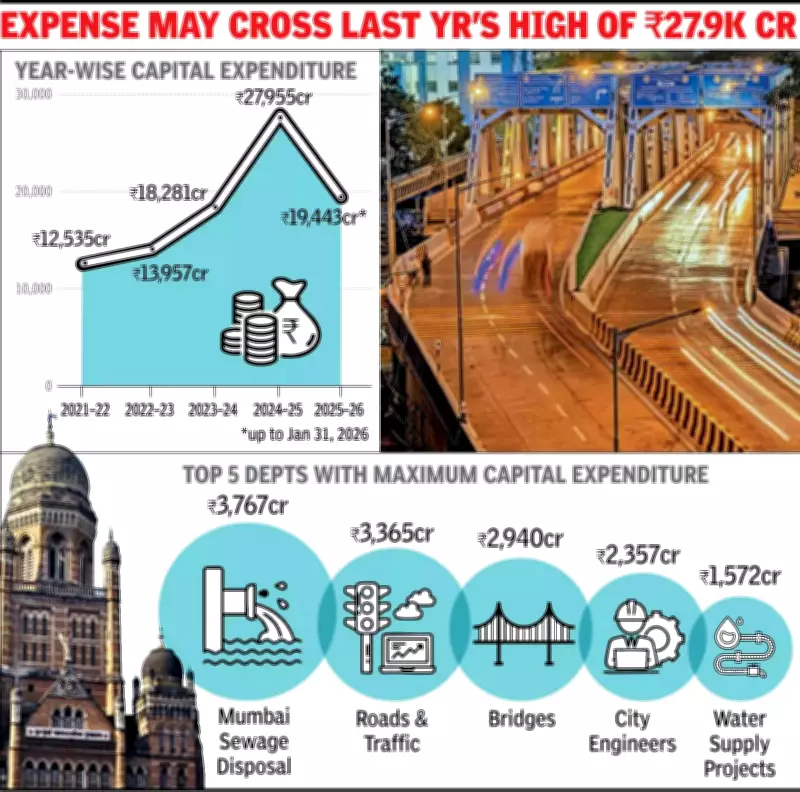
In the 2025-26 budget, the BMC allocated a significant Rs 43,162 crore specifically for capital expenditure, out of a total budget size of Rs 74,427.41 crore. According to the RTI data, which details department-wise spending, Rs 19,443 crore has already been utilized in this financial year so far. Infrastructure-focused departments have consumed the majority of these funds.
Top Spending Departments and Projects
The Roads and Traffic Department led the expenditure with projects valued at Rs 3,365 crore, followed closely by bridge construction at Rs 2,940 crore and the Mumbai Sewage Disposal Department at Rs 3,767 crore. These departments are central to some of Mumbai's most extensive ongoing infrastructure initiatives.

Road concretisation, an ambitious city-wide effort to transform all Mumbai roads into concrete surfaces, is progressing across various locations. Several major bridge projects have also advanced significantly:
- Carnac Bridge (now renamed Indore Bridge) was inaugurated last year.
- Bellasis Bridge and the Goregaon Flyover have been completed this year and are scheduled to open shortly.
- Sion Bridge construction is expected to conclude before the monsoon season begins.
Sewerage Infrastructure Expansion
Simultaneously, sewerage infrastructure is receiving substantial attention, with the Sewerage Disposal Department operating at full capacity to build 7 sewage treatment plants throughout Mumbai. This initiative aims to enhance the city's sanitation and environmental management systems.
Projected Year-End Spending and Historical Context
Civic officials note that a significant portion of contractor payments is typically processed toward the fiscal year's end, suggesting that capital expenditure for 2025-26 could easily surpass Rs 27,955 crore—the amount spent in 2024-25. This would mark another year of record infrastructure investment by the BMC.
Historically, the BMC's annual capital expenditure remained below Rs 20,000 crore until the previous financial year, which saw the highest spending in its history. Large-scale projects such as the ongoing Goregaon Mulund Link Road (GMLR) and the planned coastal road extension from Versova to Bhayander have necessitated these increased allocations.
Financial Implications and Future Considerations
However, this aggressive spending has led to a sharp rise in the civic body's liabilities, exceeding Rs 2 lakh crore. This financial pressure has prompted the BMC to explore alternative funding mechanisms, including potentially issuing bonds—a step not previously taken.
An official involved in the discussions revealed, "There are considerations around utilizing Infrastructure Investment Trusts (InvITs), which are commonly employed in India for highway projects, with NHAI's InvIT being a prominent example. InvITs aggregate investor capital to acquire or finance revenue-generating infrastructure assets."
The upcoming budget presentation will likely address these financial strategies while continuing to prioritize Mumbai's infrastructure development, reflecting the BMC's commitment to urban improvement despite growing fiscal challenges.