

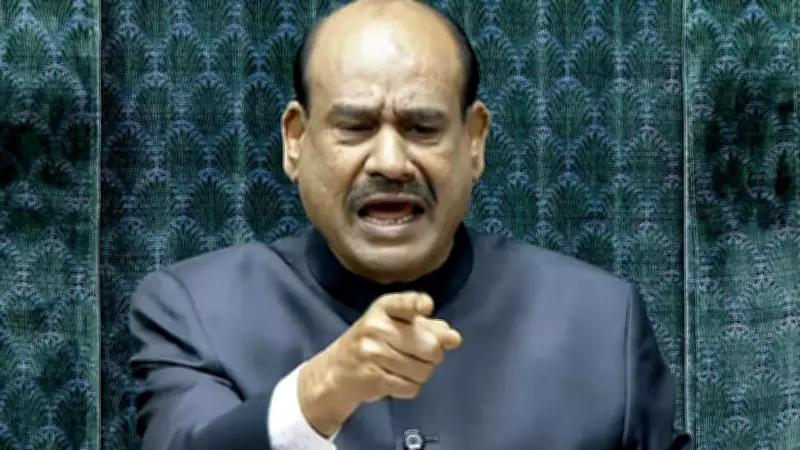
Congress Escalates Confrontation with No-Confidence Notice Against Lok Sabha Speaker
In a significant escalation of its ongoing confrontation with the BJP-led NDA government, the Congress party on Tuesday formally moved a no-confidence notice against Lok Sabha Speaker Om Birla. The opposition alleges repeated instances of blatantly partisan conduct by the Speaker during the current Budget session, including the denial of speaking time to Leader of Opposition Rahul Gandhi and the suspension of multiple Members of Parliament.
Grounds for the Motion
The Congress's no-confidence motion, which has been signed by 118 opposition MPs from various parties, cites several specific grievances. These include disallowing Rahul Gandhi from speaking in the House, failing to initiate action against BJP MP Nishikant Dubey for making unsubstantiated charges against women Congress MPs, and the suspension of eight opposition MPs. The motion explicitly references Article 94(c) of the Constitution of India, which outlines the procedure for removing a Speaker.
The notice states: "Notice of a resolution for the removal of Om Birla from the office of Speaker Lok Sabha, in terms of the provisions of Article 94(c) of the Constitution of India, has been given because of the blatantly partisan manner in which he has been conducting the business of the Lok Sabha. On several occasions, leaders of opposition parties have just not been allowed to speak, which is their basic democratic right in Parliament."

Political Reactions and Support
Congress MP Manickam Tagore took to social media platform X to explain the opposition's decision, calling it an "extraordinary step born out of extraordinary circumstances." He emphasized that while holding the Speaker in personal regard, the opposition is "pained and anguished by the consistent denial of opportunities to Opposition MPs to raise issues of public importance."
The motion has garnered support from 118 MPs, including those from the Samajwadi Party and DMK. However, another key INDIA bloc partner, the Trinamool Congress (TMC), has not yet declared its position on the matter, adding an element of uncertainty to the opposition's united front.
Background of the Conflict
The current confrontation has its roots in several contentious incidents during the Budget session. It began when Speaker Om Birla stopped Rahul Gandhi from quoting from an article that referenced an unpublished memoir of former Army chief General MM Naravane. During the discussion on the Motion of Thanks to the President's Address, the House descended into chaos as Gandhi repeatedly attempted to quote excerpts from the memoir concerning the 2020 Galwan Valley clash with China.
Additionally, Birla suspended eight Congress MPs over repeated disruptions in the House. In another controversial move, on February 4, the Speaker advised Prime Minister Narendra Modi not to come to the House to deliver his much-anticipated speech, citing information that some Congress MPs might rush to the Prime Minister's seat and "resort to an unprecedented incident."
Rahul Gandhi has strongly refuted these claims, asserting that PM Modi avoided attending the House because of the issues he was raising. "The issue began a few days ago when the Naravane book came up. The government did not want me to discuss it and therefore stalled the House," Gandhi stated. "The fact is very clear, the Prime Minister was afraid to come to the House, not because of the members, but because of what I was saying. He is still afraid because he cannot face the truth."
Claims and Counterclaims
The conflict has further intensified with a series of letters exchanged between women MPs from both sides. A group of women MPs from the Congress sent a strongly worded letter to Om Birla, accusing him of making "false and defamatory allegations" against them. They expressed "deep anguish and a strong sense of constitutional responsibility" over what they described as baseless accusations.

This was countered by a letter from women parliamentarians of the BJP to Speaker Birla, alleging that Congress MPs had crossed parliamentary limits. The BJP MPs claimed that opposition women MPs "surrounded the Prime Minister's seat" and later aggressively approached the Speaker's chamber on February 4. They urged the Speaker to take "the strongest possible action" against those involved.
Parliamentary Affairs Minister Kiren Rijiju added fuel to the fire by sharing a video of the stand-off that unfolded in Lok Sabha on February 4. Rijiju slammed the Congress for 'egging on' its women MPs to block the alley where the Prime Minister would have walked into the House, praising BJP lawmakers for displaying maturity and restraint that prevented "complete bedlam."
Constitutional and Procedural Aspects
Article 94(C) of the Constitution specifically deals with the procedure for moving a no-confidence motion against the Lok Sabha Speaker. It states: "A member holding office as Speaker or Deputy Speaker of the House of the People may be removed from his office by a resolution of the House of the People passed by a majority of all the then members of the House." The article further stipulates that no such resolution can be moved unless at least fourteen days' notice has been given.
According to the Rules of Procedure and Conduct of Business in the Lok Sabha, any member can seek the removal of the Speaker by submitting a written notice along with the full text of the resolution to the secretary-general of the House. Once received, a motion seeking leave to move the resolution is entered in the List of Business. The date for taking up this motion is fixed by the Chair—usually the Deputy Speaker, as the Speaker cannot preside over proceedings concerning his own removal.
The Chair then places the motion before the House and asks whether leave should be granted to take it up. At least 50 members must rise in support for the motion to proceed. If this threshold is not met, the motion fails. If accepted, it is put to a vote through voice vote, division of votes, or other prescribed means.
Political Implications and Historical Context
Despite securing 118 signatures, the motion's success remains uncertain as it ultimately depends on the Deputy Speaker's decision on whether it will be admitted. For a resolution to be admissible, it must meet specific conditions: it should be specific with respect to charges, clearly stated without ambiguity, precisely expressed without vague claims, and free from arguments, inferences, ironical expressions, imputations, or defamatory statements.
The motion appears more symbolic than practical, as removing the Lok Sabha Speaker requires an effective majority—a majority of the present strength of the House excluding vacant seats. The BJP-led NDA enjoys a comfortable majority with 293 seats in the 543-member House, while the INDIA bloc holds 238 seats, falling short of the required numbers. However, if discussed, the motion would give the opposition a platform to formally record its charges against Speaker Birla.
Historically, such motions have been rare and typically used to question the moral authority of the Chair rather than to unseat it. This is not the first time the opposition has moved a no-confidence motion against a presiding officer. Earlier in 2024, a similar motion was moved against then Rajya Sabha Chairman and Vice-President Jagdeep Dhankhar, but Deputy Chairman Harivansh dismissed it as an act of impropriety.
Since Independence, there have been at least three instances of no-confidence motions against Speakers: against the first Lok Sabha Speaker GV Mavalankar in 1954, against Speaker Sardar Hukum Singh in 1966, and against Speaker Balram Jakhar in 1987. All previous attempts were ultimately unsuccessful, setting a precedent that suggests the current motion faces significant hurdles.





