Congress MP Raises Alarm Over Punjab Officials' Presence at AAP-Linked Event
Congress MP and former deputy chief minister Sukhjinder Singh Randhawa has formally raised what he describes as a "serious institutional concern" regarding the participation of Punjab's top administrative and police officials at a state government event in Moga that displayed strong political characteristics.
Letter to Union Minister Highlights Protocol Violations
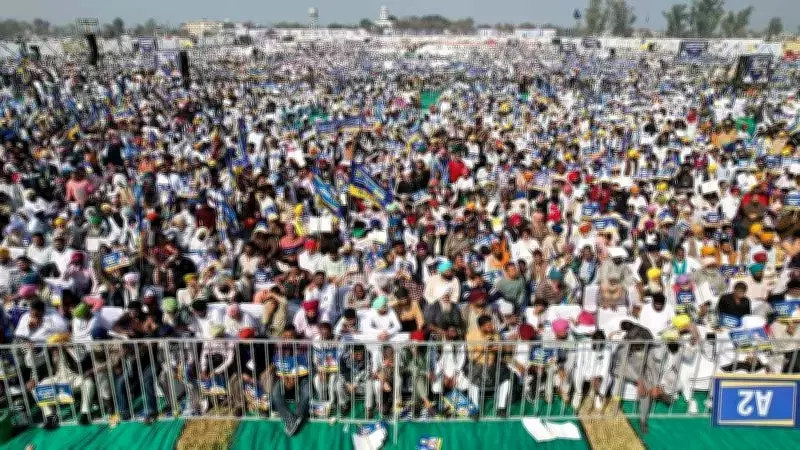
In his letter addressed to Union Minister of State for Personnel, Public Grievances and Pensions Jitendra Singh, Randhawa detailed multiple protocol concerns surrounding the event that was officially projected as part of Punjab's campaign against drugs. The Congress leader emphasized that "by all visible indications, the gathering had the character of a political rally organized by the Aam Aadmi Party."
Randhawa specifically noted:

- Repeated display of AAP party flags and insignia throughout the venue
- Partisan sloganeering by audience members supporting the ruling party
- Presence of AAP national convener Arvind Kejriwal as chief guest
- Attendance of party leader Manish Sisodia on the dais
- Chief Minister Bhagwant Mann's participation despite health issues
Violation of All India Services Conduct Rules
The Congress MP cited the All India Services (Conduct) Rules, 1968, particularly Rule 5 which explicitly prohibits members of All India Services from participating in political activities or publicly associating with political parties. Randhawa emphasized that senior officials including the Director General of Police and Chief Secretary are bound by the doctrine of political neutrality.
He further referenced the Supreme Court's landmark judgment in Prakash Singh v. Union of India (2006), which emphasized the critical importance of insulating police forces from political influence to maintain institutional integrity.
Potential Consequences of Blurred Lines
Randhawa warned that such developments, if left unexamined, could have serious institutional consequences:
- Erosion of public confidence in the impartiality of civil services and police
- Blurring of distinction between the State apparatus and the ruling political party
- Undermining of administrative neutrality essential for democratic governance
The Congress MP has formally requested that the Union government seek a factual report from the Punjab government regarding the precise nature of the Moga event and the specific roles played by the Chief Secretary and DGP. He has urged examination of whether their participation complied with service conduct rules and whether disciplinary action might be warranted.
AAP's Defense and Counter-Accusations
Responding to Randhawa's allegations, AAP Punjab state media in-charge Baltej Pannu defended the officials' presence, stating: "Those who are questioning the presence of officers at the event perhaps forgot that this war against drugs is not only the government's war, but a collective fight of the police, administration and the people."
Pannu further criticized the Congress leader's timing, asking: "Why did his pen not move at the time when the people of Punjab were deceived by Congress with a false oath on eradicating drugs? Today, when the police, administration and public are united in fighting against drugs, Randhawa Sahib is writing letters to the Centre."
The AAP spokesperson highlighted that the Village Defense Committee oath-taking ceremony had administered pledges to 1.25 lakh members, reflecting the government's commitment to combating drug abuse. He suggested that traditional political parties felt discomfort seeing such unified efforts against drugs, particularly those parties that had allegedly benefited politically from Punjab's drug problems in the past.
This controversy highlights ongoing tensions between political neutrality requirements for senior bureaucrats and police officials versus government initiatives that may carry political overtones, particularly in election-sensitive states like Punjab where drug eradication remains a critical public policy issue.