Congress Parliamentary Party chairperson Sonia Gandhi has launched a sharp attack on the central government, vowing to counter what she termed a deliberate "attack" on the Mahatma Gandhi National Rural Employment Guarantee Act (MGNREGA). Her strong statement comes just days after Parliament passed the new VB-G RAM G Bill, which replaces the landmark UPA-era scheme.
Bulldozing a Legacy: Sonia Gandhi's Stern Accusation
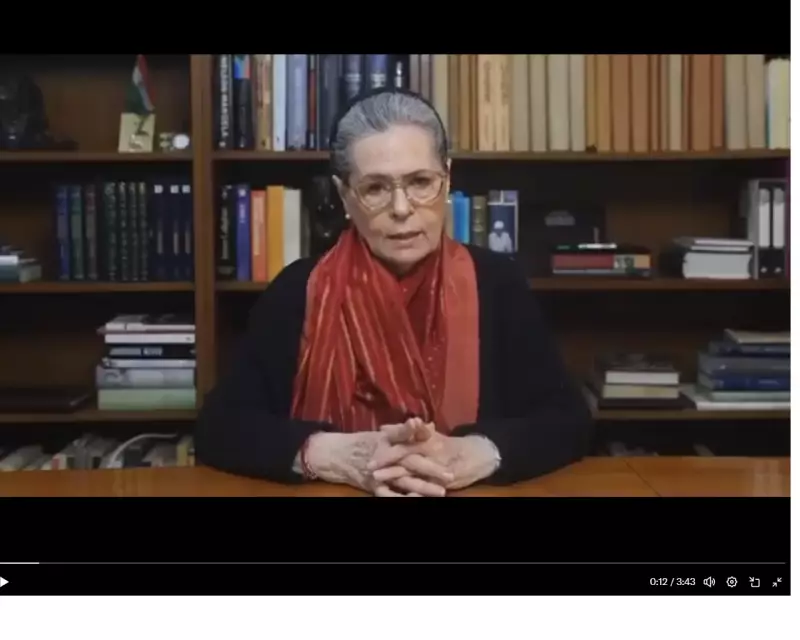
In a video statement released on Saturday, December 20, 2025, Sonia Gandhi accused the BJP-led government of systematically weakening MGNREGA over the last eleven years. She asserted that the interests of the unemployed, the poor, and deprived sections were ignored during this period.
"Through MGNREGA, a concrete step was taken towards realising the dream of an India based on Mahatma Gandhi’s vision of Gram Swaraj," Gandhi stated. "But it is a matter of great regret that just recently, the government ran a bulldozer over MGNREGA." She highlighted that not only was Mahatma Gandhi's name removed, but the law's form and structure were changed arbitrarily without deliberation or consultation with the opposition.

Gandhi criticized the new law for centralizing power, stating that decisions on "who will get employment, how much, where and in what manner, will be taken by the government in Delhi — away from the ground reality." She emphasized that while Congress was instrumental in bringing MGNREGA, it was always a scheme for national and public interest, not merely a party issue.
The Political Calculus Behind Congress's Pivot
The Congress party's decision to make the MGNREGA overhaul its central line of attack is a calculated political move. Following the Bihar election results, where issues like the Special Intensive Revision (SIR) of electoral rolls did not yield expected returns, the party is shifting focus.
Congress strategists believe this issue offers a two-fold advantage. First, it is likely to garner support from other opposition parties, especially those critical of the new funding pattern that increases the financial burden on states. For instance, Trinamool Congress in West Bengal has already rebranded its state scheme after Mahatma Gandhi.
Second, the party perceives the BJP as more vulnerable to a well-articulated critique on a core livelihood issue like rural employment. A campaign focusing on rural incomes, previously a BJP talking point, is seen as having greater potential to resonate with the public.
Key Changes and the Road Ahead
The new VB-G RAM G Bill increases guaranteed employment days from 100 to 125. However, it fundamentally alters the funding structure. Under the old MGNREGA, the Centre bore the entire wage cost and 75% of material costs. The new law mandates a 60:40 cost-sharing ratio between the Centre and states for all expenses. Furthermore, the Centre will decide state-wise annual allocations, with states bearing any expenditure beyond this limit.
In response, the Congress has announced a meeting of its Congress Working Committee on December 27 to chalk out a plan for nationwide protests. Sonia Gandhi, recalling her fight for employment rights two decades ago, declared, "We are all ready to counter this attack... Today, I remain committed to fighting against this draconian law." She pointed out that MGNREGA served as a lifeline for the poor during the COVID-19 pandemic.
By positioning itself as the defender of a scheme that brought it significant rural goodwill, the Congress aims to nullify the BJP's attempts to claim the space of pro-poor governance. The battle over MGNREGA is set to become a major political flashpoint, testing opposition unity and the government's narrative on rural development.