

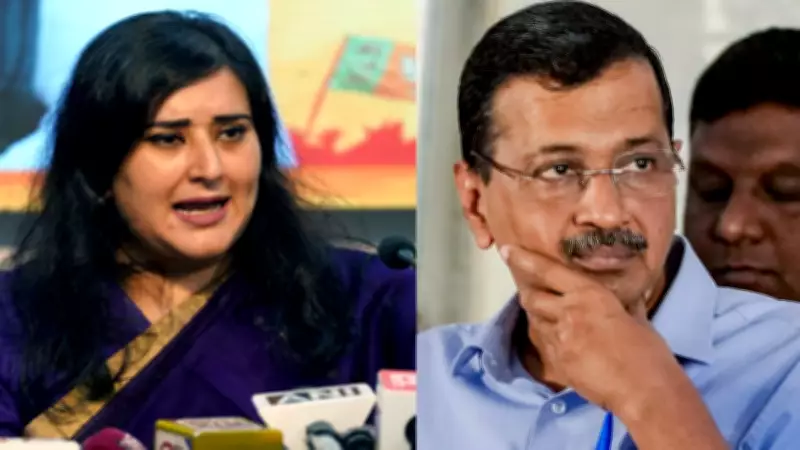
Delhi High Court Rejects Kejriwal's Recusal Plea, BJP MP Launches Sharp Attack
A significant political confrontation unfolded in New Delhi on Tuesday as the Delhi High Court dismissed a plea filed by Arvind Kejriwal seeking the recusal of Justice Swarana Kanta Sharma from the ongoing Delhi excise policy case. This judicial decision immediately triggered a forceful verbal assault from Bharatiya Janata Party Member of Parliament Bansuri Swaraj, who accused the Aam Aadmi Party national convenor of attempting to unduly influence the judiciary.
BJP MP Accuses Kejriwal of Judicial Pressure Tactics
Reacting swiftly to the court's ruling, BJP parliamentarian Bansuri Swaraj launched a scathing critique against the AAP leadership. "Arvind Kejriwal is a bully. You tried to pressurise a female member of the judiciary of this country," she asserted emphatically. Swaraj contended that the court's refusal to transfer the case had effectively exposed what she characterized as the Aam Aadmi Party's "politics of creating pressure on the judiciary." She further escalated her criticism by alleging that the political party operates similarly to a "drama company" with Kejriwal serving as its principal "director."
Court Delivers Detailed Order Rejecting Recusal Request
In a comprehensive and meticulously reasoned order, Justice Swarana Kanta Sharma firmly rejected the recusal application submitted by Kejriwal and other senior AAP leaders. The judge observed that the claims presented in the plea were fundamentally "based on conjectures and insinuations" rather than substantive evidence. Justice Sharma explicitly underlined that no credible material had been presented before the court to indicate any form of ideological bias on her part.

"Floodgates cannot be opened to sow seeds of mistrust," the court declared authoritatively, cautioning that permitting such recusal pleas without solid foundational grounds could progressively erode public confidence in the judicial system. The judge further noted that recusal in these particular circumstances might incorrectly suggest that judges are inherently aligned with specific political ideologies, thereby damaging the perception of judicial impartiality.
Court Addresses Specific Allegations of Bias
Addressing the specific allegations raised within the recusal petition, Justice Sharma provided clear clarifications regarding her professional engagements. She explained that her participation in events organized by the Akhil Bharatiya Adhivakta Parishad did not constitute political involvement or affiliation. These were strictly professional or academic programmes, including detailed discussions on new criminal legislation and constructive interactions with members of the legal bar, and therefore could not reasonably be utilized to infer judicial bias.
Concerning the issue of alleged conflict of interest involving family members serving on government panel counsel, the court maintained that no direct nexus had been satisfactorily established. "The litigant has to show the impact of that on the present case or the decision-making power of this court. No such nexus has been shown," Justice Sharma stated unequivocally. In a particularly strongly worded observation, the judge remarked that the recusal plea had effectively placed the judiciary itself "on trial," while adding that her order had been composed without being influenced by any external factors or pressures.
Separate Development in Related Legal Proceeding
In a related judicial development, Justice Swarana Kanta Sharma recused herself from hearing a separate bail application filed by former AAP Member of Legislative Assembly Naresh Balyan in a case registered under the stringent Maharashtra Control of Organised Crime Act. This particular legal matter will now be heard by another judicial bench on April 23, according to official court scheduling.






