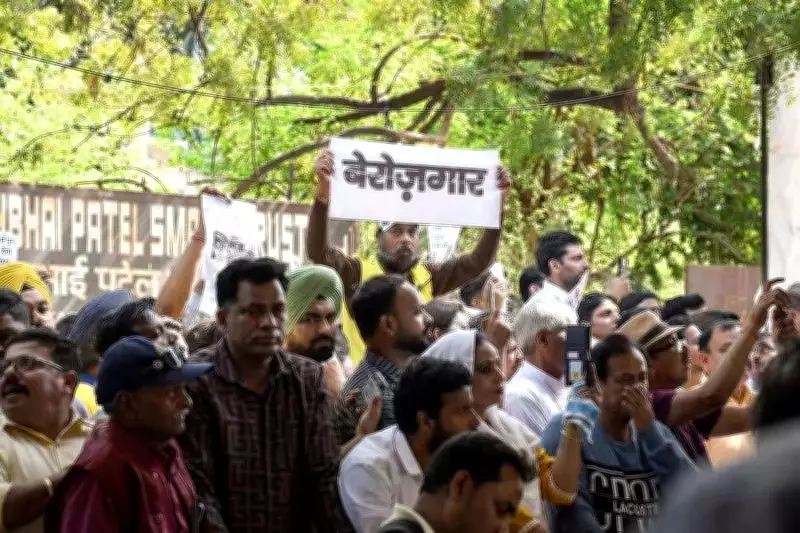
Delhi Transport Workers Stage Protest Over Job Losses at AAP Rally
In a significant display of discontent, former bus conductors who lost their positions during the DIMTS-to-DTC transition and unemployed bus marshals became prominent participants at the Aam Aadmi Party's gathering at Jantar Mantar on Sunday. The assembly highlighted widespread job losses and prolonged uncertainty stemming from administrative changes within Delhi's public transport infrastructure, with numerous individuals vocally demanding reinstatement or absorption into government services. Many articulated that their contractual roles had been abruptly terminated without adequate recourse or alternative employment opportunities.
Voices from the Ground: Personal Stories of Hardship
While addressing the sizable crowd, Delhi Chief Minister Arvind Kejriwal explicitly acknowledged this segment of protesters, gesturing and waving towards them in a show of solidarity. Jagbir, a former bus conductor who worked on route number 73, provided a poignant account of the transition's impact. "Approximately 650 people are present here today, but overall, more than 10,000 families have been adversely affected. We were assured that we would be granted permanent positions. Even at this moment, our sole demand remains reinstatement into the system," he stated emphatically.
For numerous attendees, Sunday's demonstration reflected deep-seated unresolved uncertainties regarding their livelihoods. Prem Jeet, who identified himself as a representative of the affected workers, critically questioned past political assurances. "Where have all the promises disappeared? If permanent employment was unattainable, why were we given such assurances initially? Absolutely nothing has materialized thus far. We insist on being reinstated or provided with permanent job opportunities," he declared.

Frustration Among Former Civil Defence Volunteers
Former civil defence volunteers, who previously served as bus marshals, also expressed considerable frustration during the event. One volunteer pointed out inconsistencies in policy implementation, stating, "We were informed that civil defence personnel are required exclusively during emergencies, yet presently, many continue to be posted across various government departments. Why were some individuals removed while others retain their positions?"
Additional participants described how operational alterations left them entirely without work. Vishal, another ex-bus conductor, claimed that while drivers were re-absorbed into the system, conductors were conspicuously left out. "Thousands lost their jobs following DTC's takeover. We were told merely that the company was changing, but everything transformed detrimentally for us," he lamented. Babu Ram, a worker associated with bus operations, echoed similar concerns, asserting, "Since we were operating within a government framework, we should never have been laid off in such a manner."
Root Causes: Policy Conflicts and Administrative Shifts
The grievances originate from a complex policy conflict that emerged after thousands of civil defence volunteers deployed as bus marshals on DTC and cluster buses lost their positions. Authorities questioned the legality of utilizing them for routine transport duties instead of emergency response work, leading to halted payments and discontinued deployments. This decision ignited a prolonged political struggle, with affected individuals repeatedly staging protests to seek reinstatement.
Simultaneously, conductors employed under Delhi's cluster bus system, previously operated through the Delhi Integrated Multi-Modal Transit System (DIMTS), face escalating uncertainty as services were gradually integrated into the DTC framework. Many hired through private operators on contractual terms were not absorbed into the permanent workforce upon contract expiration or during service model transitions. Worker groups argue that despite performing duties analogous to regular staff for years, neither were their services regularized nor were they redeployed, leaving them in a precarious employment limbo.