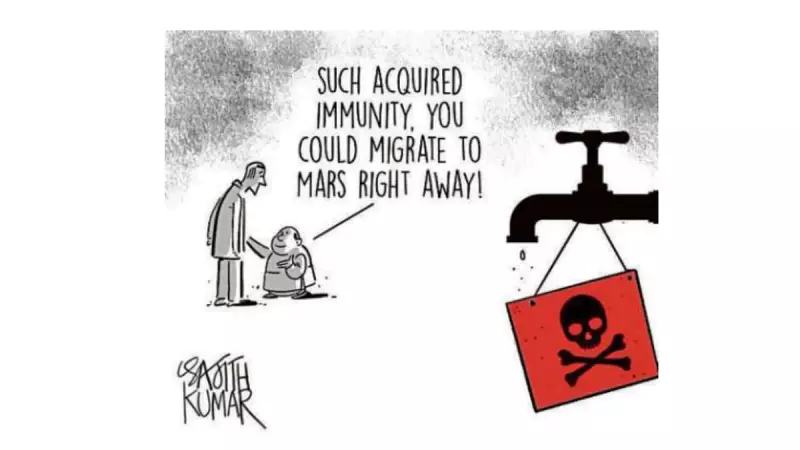
In a pointed piece of visual commentary, the editorial team at Deccan Herald has released a new cartoon that takes a satirical swing at the notion of 'acquired immunity' within the public and political spheres. The artwork, featured in the newspaper's esteemed opinion section, uses sharp wit and symbolic imagery to critique a phenomenon familiar to many observers of contemporary discourse.
The Art of Satire in Editorial Cartoons
Editorial cartoons have long served as a powerful tool for social and political critique, distilling complex issues into a single, impactful frame. The Deccan Herald cartoon continues this tradition. It visually interprets the idea of 'acquired immunity' not in a medical sense, but as a metaphorical condition. The artist suggests that certain entities or individuals in public life develop a resistance to accountability, criticism, and the consequences of their actions, much like a body builds immunity to a pathogen.
This form of immunity, the cartoon implies, is not innate but is acquired over time through repeated exposure to scandals, controversies, and public scrutiny without facing significant repercussions. The strength of such cartoons lies in their ability to provoke thought and discussion without a single word, relying on universally understood symbols and scenarios.

Decoding the Visual Metaphor
While the specific visual elements are best viewed in the original publication, the core concept is clear. The cartoonist employs familiar imagery to represent institutions, figures, or behaviors that appear impervious to the usual mechanisms of answerability. The tone is typically wry and observational, holding up a mirror to societal dynamics where narratives often overshadow facts, and perception management becomes a key skill.
The artwork moves beyond mere mockery to offer a critical observation on the state of public accountability. It questions what happens when repeated exposures to allegations or failures do not lead to corrective action but instead inoculate the subject against future charges. This satirical perspective encourages readers to reflect on the health of democratic dialogue and institutional robustness.
Broader Implications and Public Conversation
The publication of this cartoon is more than just a daily editorial feature; it is a contribution to an ongoing national conversation. In a vibrant democracy like India, the media's role as a watchdog and a platform for critique is paramount. Cartoons like this one serve as a cultural barometer, capturing the public mood and intellectual concerns of the moment.
By choosing 'acquired immunity' as its theme, the cartoon taps into a widely recognized sentiment. It speaks to a perceived gap between action and consequence in various fields, be it politics, corporate governance, or public administration. The discussion it sparks is its primary value, prompting readers to consider:
- The erosion of accountability in powerful circles.
- The role of satire and free press in a healthy society.
- The public's own role in challenging or accepting this 'immunity.'
Deccan Herald's opinion section, through this cartoon, reaffirms the importance of editorial freedom and artistic expression in journalism. It demonstrates how traditional media continues to leverage timeless tools like caricature and metaphor to engage with modern, complex issues. The cartoon does not provide answers but succeeds brilliantly in posing an important, visually compelling question about the resilience—or resistance—of our public institutions and figures to the antibodies of scrutiny.